Industries / 行业: Other Cases

  • Hospital Cell Culture Room: Mycoplasma Investigation and Response

    Project background

    VanTsteri's company account describes mycoplasma contamination during cell recovery at an anonymous hospital's cell culture facility. The account reports related mycoplasma findings in environmental samples and continued contamination after initial treatment.

    Investigation and response

    The investigation considered culture media and serum, incubators, biological safety cabinets, cleaning practices and ventilation. The described response addressed process equipment, cold-storage equipment, the room environment and the HVAC system, alongside continued monitoring and discussions about hygiene controls.

    Company-reported outcome

    The source reports that the combined investigation and environmental response brought the cell-room contamination problem under control. It provides no project-specific sample count, detection limit or measured log reduction.

    Relationship to other source accounts

    It has not been confirmed whether this account and the other mycoplasma-related cell-facility account concern the same project. Equipment allocations and outcomes are not transferred between them.
  • Pheasant Hatchery: A Project-Specific Environmental Response

    Investigating a hatchery concern and reviewing a tailored environmental response.

    A concern in a nationwide breeding business

    User-provided reference photograph of a long-tailed bird standing on grass beside a fence
    User-provided scene reference; not verified as the customer’s facility or evidence of treatment results.

    An anonymous pheasant breeding business supplying breeding birds nationwide sought VanTsteri’s support after eye infections appeared among newly hatched chicks. According to the company representative’s account, testing and a review by disease-control personnel identified chlamydial involvement.

    The finding described concerns a bacterial organism, not a virus. VanTsteri investigated the facilities and environment to understand the project’s needs.

    Different stages, different treatment scopes

    The project distinguished between vaporized hydrogen peroxide (VHP) terminal treatment of the environment and equipment between batches, and a proprietary dynamic environmental treatment programme during hatching. The dynamic programme is not presented as the same technology as the between-batch VHP treatment.

    The company representative describes the latter as a professional project arrangement during a stage when chicks were present. This historical account does not provide instructions for chemical treatment around live birds or recommend applying chemicals to birds.

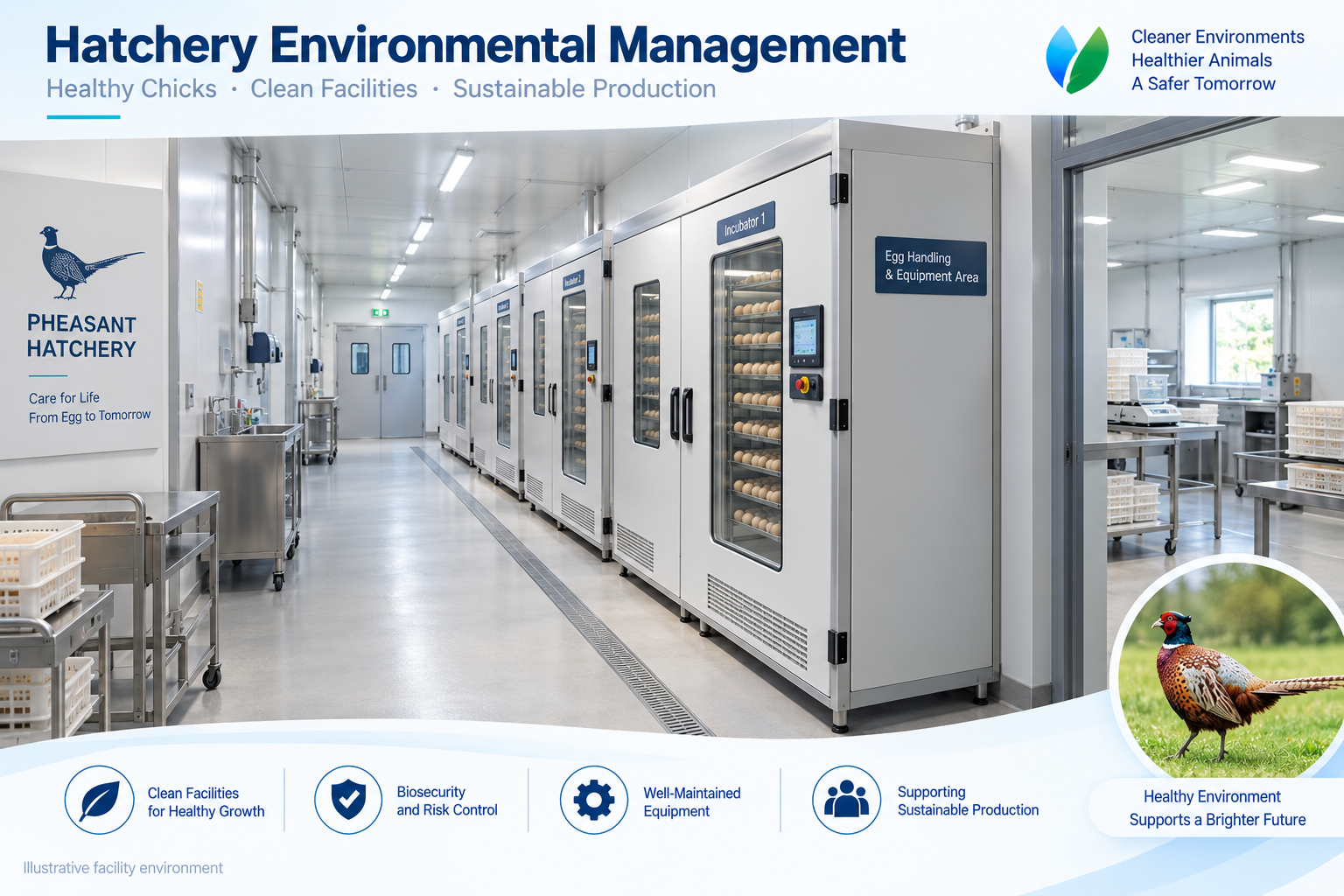
    Illustrative pheasant hatchery facility with enclosed incubation equipment, egg-handling areas and no treatment activity
    Illustrative facility environment; not the customer’s actual facility, a treatment procedure or evidence of bird recovery.

    A defined project scope

    Investigation
    Review facilities and the environment
    Between batches
    Environmental and equipment VHP terminal treatment
    During hatching
    A separate proprietary environmental programme

    Observations reported by the company representative

    In subsequent checks, the examined chicks’ tracheas did not show the injury described in the account. This observation relates to the chicks and checks reported; it does not establish comprehensive safety for animals or other applications.

    The representative also reported temporarily lighter feather colour. As the birds grew and replaced their feathers, their plumage became brighter. This change is retained as part of the account and is not described as proof that the treatment had no adverse effects.

    The representative reports that later reviews did not identify a similar outbreak. No follow-up duration was provided, so this is presented as a reported observation rather than a permanent prevention claim.

    Follow-up with a clear evidence boundary

    The company representative describes interest from the local agricultural department. This is not presented as an approval or certification of the treatment.

    The case illustrates a project-specific response informed by the facility and its operating context. It does not publish a disease-incidence percentage, a killing-rate claim or a general guarantee of chick safety.

    Discuss your facility’s environmental requirements

    VanTsteri can help review an environmental concern and define a suitable service scope, including where between-batch VHP terminal treatment may be relevant. Assessment and verification requirements are considered for the actual project.

    Discuss hatchery environmental support →

  • Care Home: From VHP Service to Long-Term Robotic Use

    A customer relationship that developed from on-site environmental support into continued equipment use and a repeat purchase.

    Environmental support during a norovirus incident

    An anonymous care institution invited VanTsteri to provide environmental terminal decontamination support following a norovirus incident. Vaporized hydrogen peroxide (VHP) was used as part of the institution’s response to the environmental concern.

    The service provided the starting point for a longer relationship between the customer and VanTsteri. This story focuses on the subsequent equipment application and purchasing history, as reported by the company.

    From on-site service to equipment application

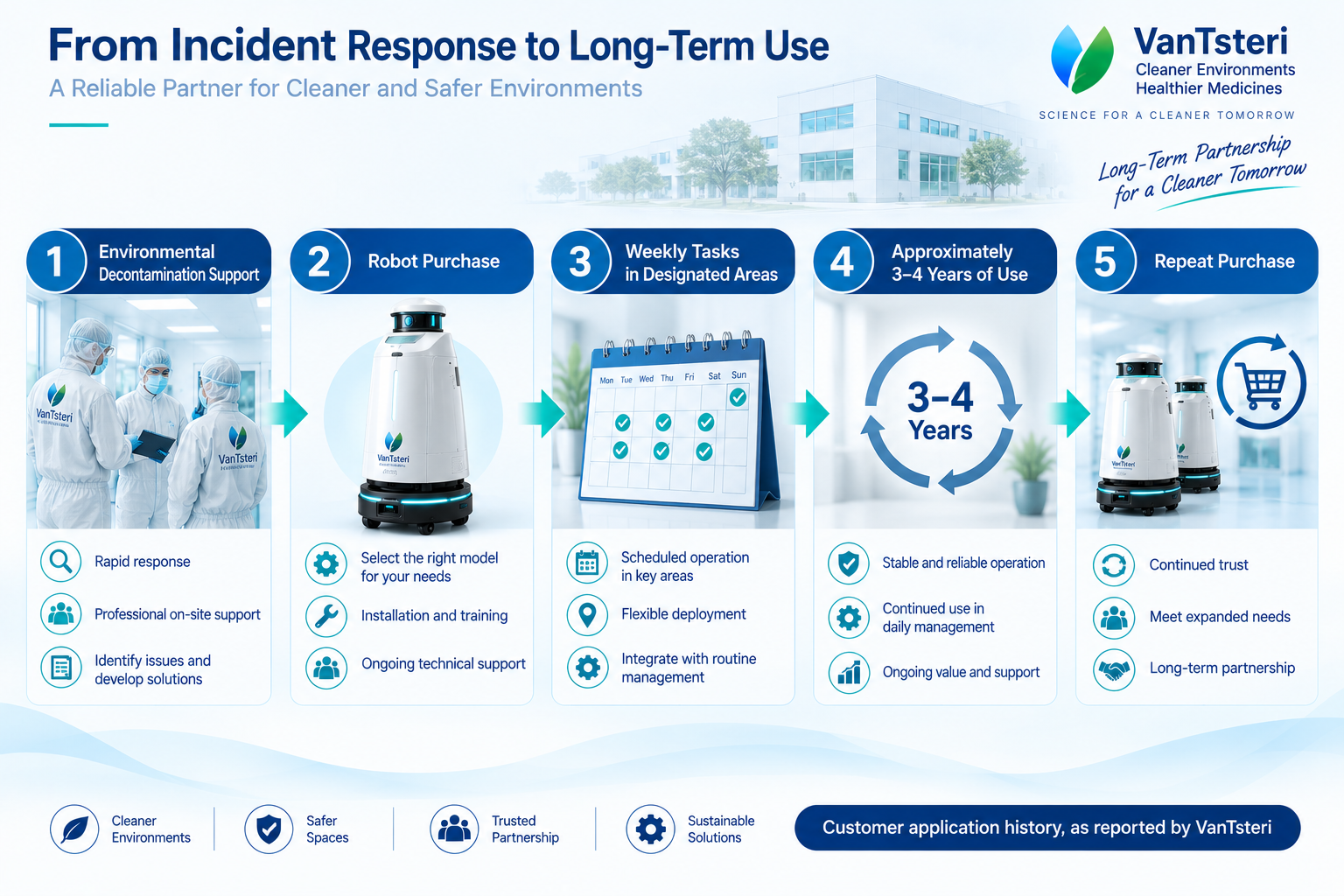
    After the on-site service, the institution purchased a VanTsteri decontamination robot. According to VanTsteri’s account, the customer arranged tasks in designated areas each week as part of its own environmental management.

    This schedule describes the customer’s application. Equipment suitability, treatment areas and task arrangements are assessed against the needs of each facility.

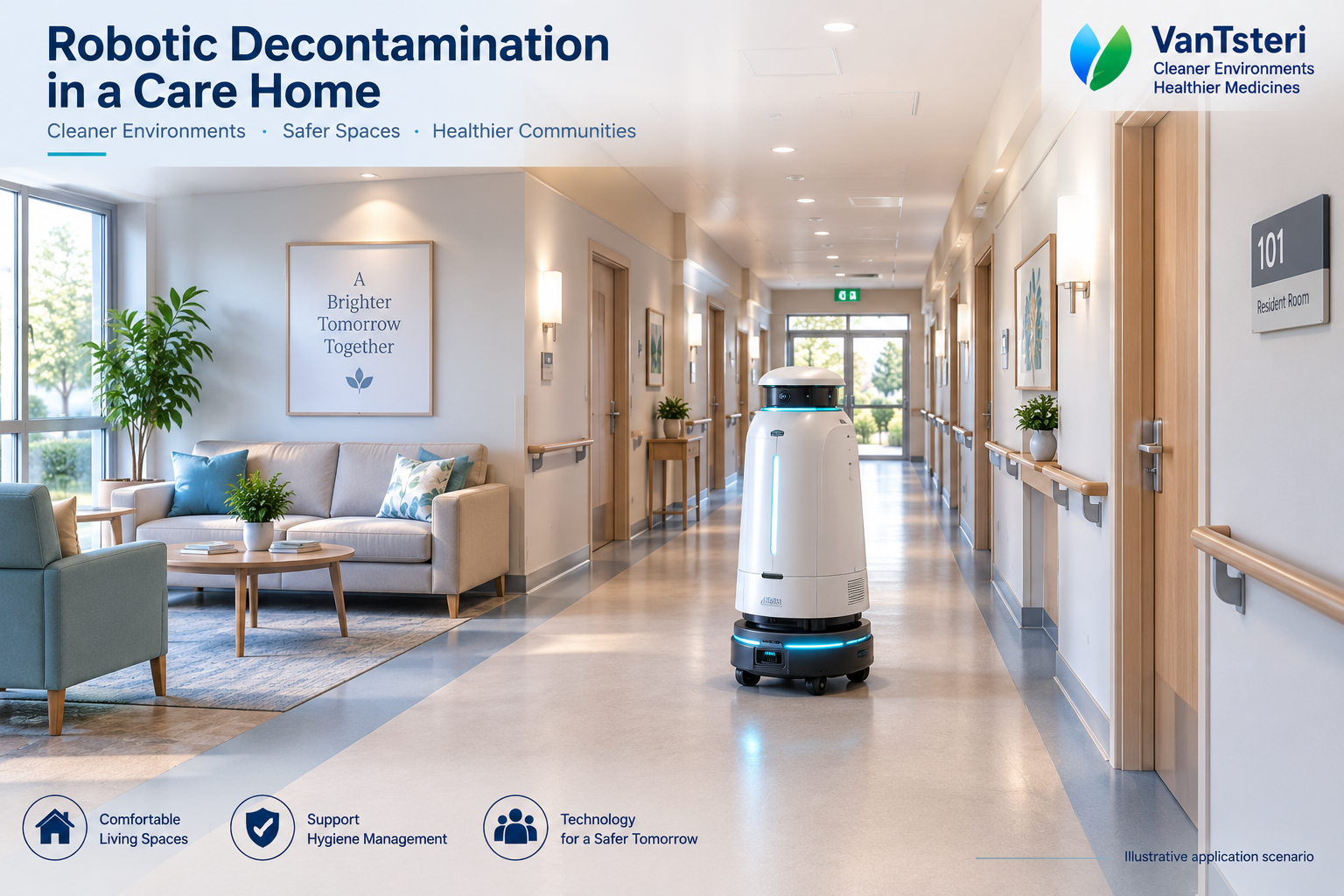
    Illustrative decontamination robot in an unoccupied care home corridor
    Illustrative application scenario; not a photograph of the customer facility.

    Equipment in daily management

    Service starting point
    Environmental VHP support
    Customer application
    Weekly tasks in designated areas
    Related equipment
    Explore KINO PRO →

    A repeat purchase after approximately 3–4 years

    VanTsteri reports that the institution continued using its robot for approximately three to four years and then made a repeat purchase. The company describes this continued use and repurchase as customer recognition of the equipment’s value in its own application.

    The exact models involved in the two purchases have not been confirmed. KINO PRO is presented below as a related product reference.

    Illustrative customer history from environmental decontamination support to robot purchase, designated-area tasks, approximately three to four years of use and repeat purchase
    Illustrative partnership timeline based on company-reported customer history; supporting scenes and icons are conceptual.

    A continuing customer relationship

    First step
    On-site environmental support
    Continued use
    Robot tasks within the customer’s own schedule
    Customer history
    Approximately 3–4 years, followed by repurchase

    Related product evidence, with a defined scope

    KINO PRO’s third-party testing summary covers simulated-use surface decontamination against specified microorganisms and compatibility with specified metal specimens. Findings apply to the equipment, materials and conditions in the respective reports.

    This product evidence is separate from the care home’s application history. It is not a norovirus field-test result for this customer, and the purchasing history is not a measure of disease prevention.

    Review KINO PRO testing & material compatibility →

    Discuss support for your care environment

    From an immediate environmental concern to planned equipment use, VanTsteri can help assess your application and the support you need. Discuss your facility, designated areas and service requirements with our team.

    Discuss environmental decontamination support →