Industries / 行业: Food Manufacturing

  • Food Factory Spore Contamination Control

    Coordinated VHP treatment across a large site, with follow-up monitoring.

    From product findings to environmental investigation

    A food processing facility identified Bacillus contamination in its products and engaged VanTsteri to investigate and address it. Sampling in the associated environment also detected the same microbial species, identified in the original project record as Bacillus cereus. The investigation therefore extended from product testing to contamination assessment across the production environment.

    Planning treatment across a large production space

    The challenge involved both spore contamination and the size of the production environment. Multiple areas and HVAC-related locations needed to be included in the treatment scope. VanTsteri focused on planning equipment deployment around the site conditions and the areas requiring treatment.
    Explore contamination investigation and source tracing

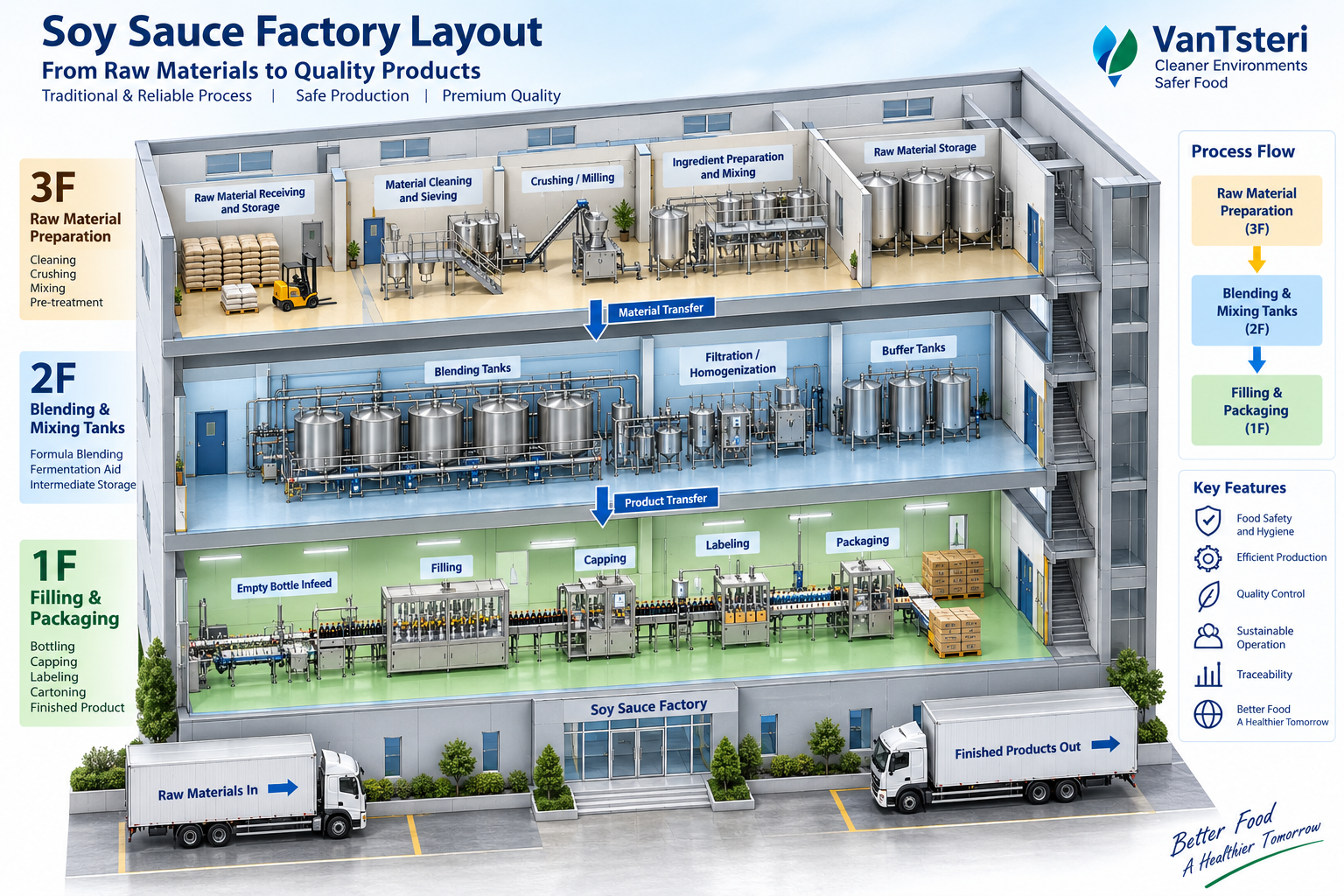
    Food factory project layout illustration
    Project layout illustration, consistent with the site arrangement confirmed by VanTsteri’s project representative. View full-size illustration

    Coordinating multiple VHP units

    The team used its own portable vaporized hydrogen peroxide (VHP) equipment to treat production areas and HVAC-related locations. The project record describes deployment of 15 units, a four-hour treatment period, and a subsequent two-hour HVAC circulation period before testing.

    Coordinated deployment was a defining feature of this project: equipment was organized around the site’s space and treatment scope. Completion of a single unit’s operating cycle alone was not used to judge the treatment outcome across the production environment.

    Explore VHP decontamination equipment

    Evaluating the outcome over seven days

    Both parties collected samples for testing after treatment. During seven consecutive days of subsequent monitoring, settle-plate, airborne microbial and surface microbial sampling did not detect the target Bacillus previously under investigation. These findings relate to this project’s sampling scope and monitoring period.

    According to VanTsteri’s project representative, the customer was satisfied with the treatment outcome.

    The value VanTsteri provided

    VanTsteri’s service connected the initial product contamination findings with an environmental investigation to define the treatment scope, coordinated deployment of multiple VHP units, and follow-up monitoring to evaluate the outcome. For food facilities with large spaces and multiple production areas, connecting investigation, equipment deployment and testing helps customers understand both the basis for treatment and its results.

    If your food facility is facing spore contamination, discuss contamination investigation, VHP equipment deployment and environmental monitoring with VanTsteri.

    Case information: This anonymized case is based on VanTsteri’s project record and supplementary information from its project representative. The customer’s identity is withheld.
    Discuss food facility decontamination

  • Pet Food Plant Salmonella Control

    Coordinated treatment across four production lines and the production environment.

    A large site with complex production systems

    A large pet food manufacturer identified Salmonella contamination and engaged VanTsteri to investigate and address it. The plant operated four production lines, including lines with daily capacities of 10 tonnes or 8 tonnes. The project involved an actual treatment area of 50,000 m², as confirmed by VanTsteri’s project representative. Its scale and the complexity of the production systems created challenges for the on-site work.

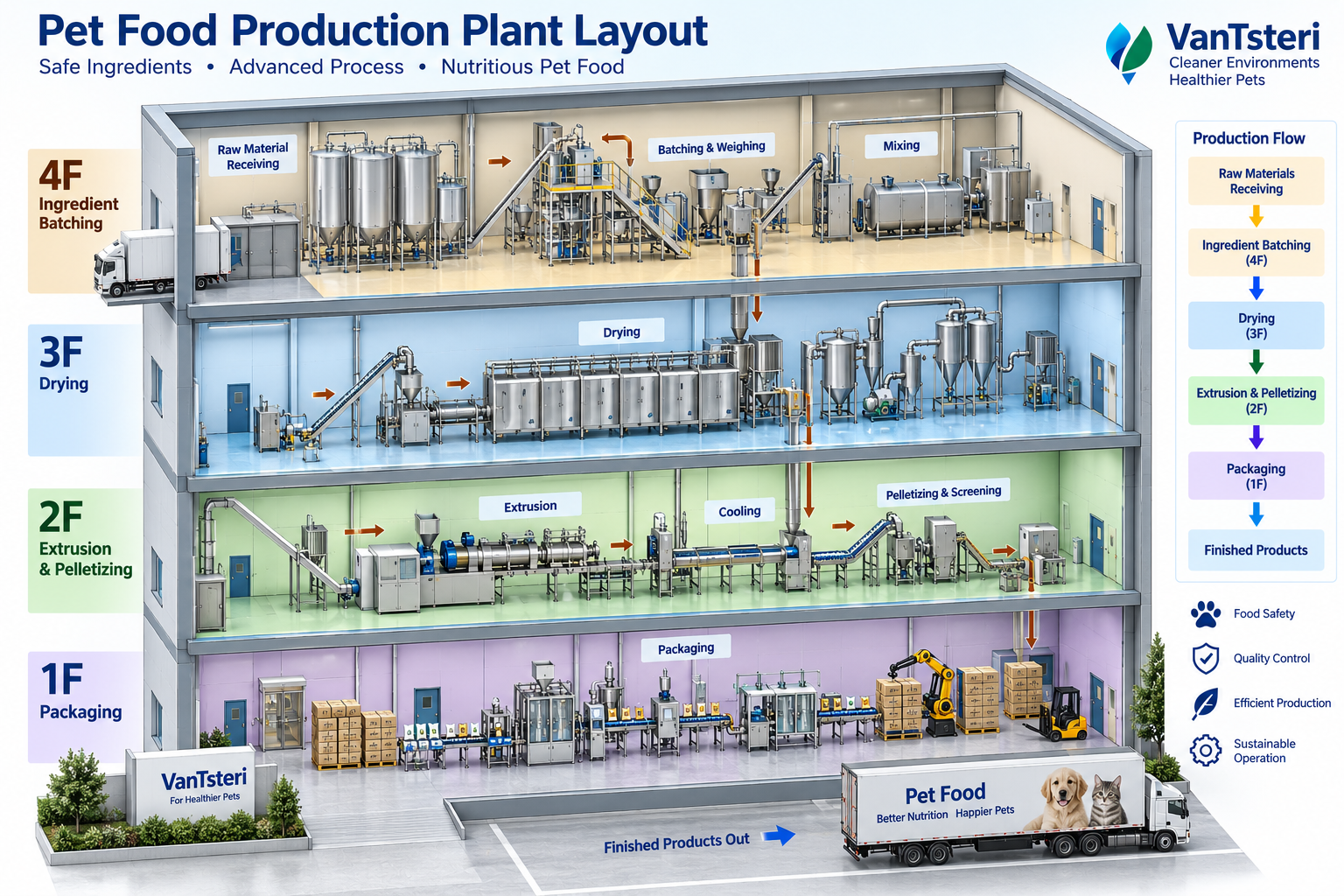
    Project process-flow illustration of the pet food plant
    Project process-flow illustration, consistent with the layout confirmed by VanTsteri’s project representative. View original illustration

    Project at a glance

    Actual treatment area
    50,000 m²
    On-site work
    7 days
    Production scope
    4 lines
    Post-treatment testing
    Within one month

    Salmonella was not detected in the environmental and product samples tested by the customer during this period.

    Tracing findings across the production environment

    The project investigation detected Salmonella in environmental samples, pipelines, products and the heating, ventilation and air-conditioning (HVAC) system. These findings guided the treatment priorities across the production process; they do not establish that the organisms detected shared the same strain or source.

    The response extended beyond an individual room or piece of equipment. The team used the production flow to identify the areas, systems and locations that needed attention.

    Explore contamination investigation and source tracing

    Coordinating seven days of on-site work

    VanTsteri organized seven days of integrated on-site treatment, covering production equipment, material-transfer pipelines, the production environment and HVAC-related areas. This was the period of on-site work, rather than a single treatment cycle or continuous application of disinfectant.

    The work focused on locations that were easy to overlook or difficult to clean, alongside raw-material management and equipment hygiene measures.

    Project highlight: managing complexity across four lines

    This project involved a large treatment scope and multiple stages of production. VanTsteri combined investigation findings with on-site organization to coordinate work across four production lines and associated systems, helping reduce the risk of overlooking parts of the production environment.

    Evaluating the outcome through the customer’s testing

    Within one month after treatment, the customer tested environmental and product samples. Salmonella was not detected in either sample category. These results apply to the actual samples tested and the period covered by this project; they do not represent daily testing, testing of every production batch or independent certification.

    The value VanTsteri provided

    The project connected contamination findings from multiple stages of production with coordinated treatment across the areas associated with four production lines, followed by the customer’s testing to evaluate the outcome. It illustrates VanTsteri’s ability to organize and carry out work in a large, complex production environment.

    If your pet food manufacturing facility is experiencing Salmonella contamination, discuss contamination investigation, treatment of production systems and the environment, and follow-up assessment with VanTsteri.

    Discuss pet food plant contamination treatment

    Related decontamination options

    For suitable pet food production environments, VanTsteri also provides vaporized hydrogen peroxide (VHP) equipment and environmental decontamination services. Suitability and treatment scope are assessed for each site. These related options do not add a specific equipment model or treatment method to the project account above.

    Explore VHP equipment

    Case information

    This anonymized case is based on VanTsteri’s project materials and information confirmed by its project representative. Customer and supplier identities are withheld.

  • Dairy Pipeline Biofilm Treatment: Company-Reported Case

    COMPANY-REPORTED CASE

    Contamination concern

    A dairy processing facility engaged VanTsteri to investigate and address recurring spore contamination in its dairy products.

    This account and the outcomes below are reported by VanTsteri and confirmed by company management. They are not presented as independent third-party verification. The customer is identified only as a dairy processing facility.

    Investigation and source tracing

    VanTsteri first assessed the microorganism associated with contamination in the dairy products. Considering spore heat resistance and the facility’s routine hot-water flushing process, the team sampled pipeline rinse water and internal pipe surfaces. According to VanTsteri’s project investigation, biofilm was present in the pipeline system.

    Pipeline biofilm treatment

    VanTsteri reports using its own technology to remove biofilm attached to the internal surfaces of the dairy processing pipelines and associated residues. Treatment effectiveness was evaluated through residue assessment and microbiological testing.

    Post-treatment assessment

    Post-treatment assessment included pH, total organic carbon (TOC), conductivity and treatment-related chemical residues. Pipeline hydrogen peroxide residues were checked and evaluated against the limit adopted for this project. The sampling medium, test method and basis for that limit are not specified in this account.

    COMPANY-REPORTED PROJECT OUTCOMES

    Project outcomes

    The following figures were provided by VanTsteri’s company representative for this project.

    24 hours from decontamination to production resumption

    VanTsteri reports that, in this project, 24 hours elapsed from the start of decontamination to the resumption of production. This interval does not describe the entire investigation and cleaning workflow or establish a turnaround time for other projects.

    Reported total viable count: <10 CFU/mL

    VanTsteri reports a total viable count of <10 CFU/mL in post-treatment surface-sampling liquid collected after sampling tank openings and internal tank walls.

    The value refers to the surface-sampling liquid, not the dairy product or a direct surface count in CFU/cm2. It is not a spore-specific log-reduction result or a general statutory food-safety threshold.

    Investigation, targeted treatment and verification

    According to VanTsteri, investigation, biofilm treatment and post-treatment testing helped the customer locate and address the contamination source in the production pipelines and provided a basis for subsequent contamination control.

    Related decontamination options

    VanTsteri also provides vaporized hydrogen peroxide (VHP) equipment and environmental decontamination services for suitable applications. The scope and operating conditions are assessed for each site. This related option is not identified as the biofilm-removal method used in this project.

    Explore VHP equipment

    Source and scope

    Source: VanTsteri’s company account and the responsible company representative’s clarification. The customer name and identifying location details are withheld. The reported result applies to the described project and sampling context; it does not establish performance for other facilities or operating conditions.

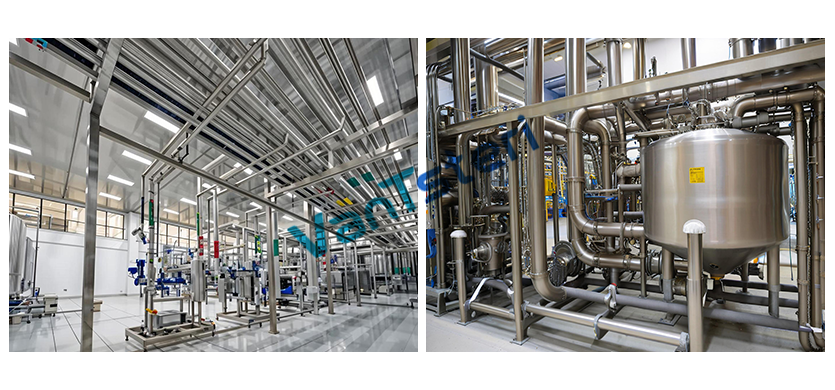
    Archive photograph retained for local review
    Archive photograph for local review. Project association and publication permission remain subject to separate confirmation.
    Discuss a contamination project