Understand the contamination
Bring together microbial identification, monitoring history and on-site findings to assess the issue in its facility and process context.
MICROBIAL CONTAMINATION CONTROL STRATEGY
Understanding the microorganisms involved, their potential sources and how they spread provides a basis for targeted control measures. Investigation connects site observations and laboratory findings with corrective actions and ongoing contamination control.
Bring together microbial identification, monitoring history and on-site findings to assess the issue in its facility and process context.
Use the findings to inform improvements to cleaning and decontamination, equipment practices, personnel activities and relevant workflows.
Use follow-up observations and monitoring trends to review the response, refine control measures and help reduce the risk of recurrence.
When investigation helps
Similar observations return after earlier actions.
Findings are available, but their origin or significance remains uncertain.
A monitoring finding requires further assessment in its actual setting.
Recent changes to rooms, equipment, or workflows need to be considered alongside the observations.
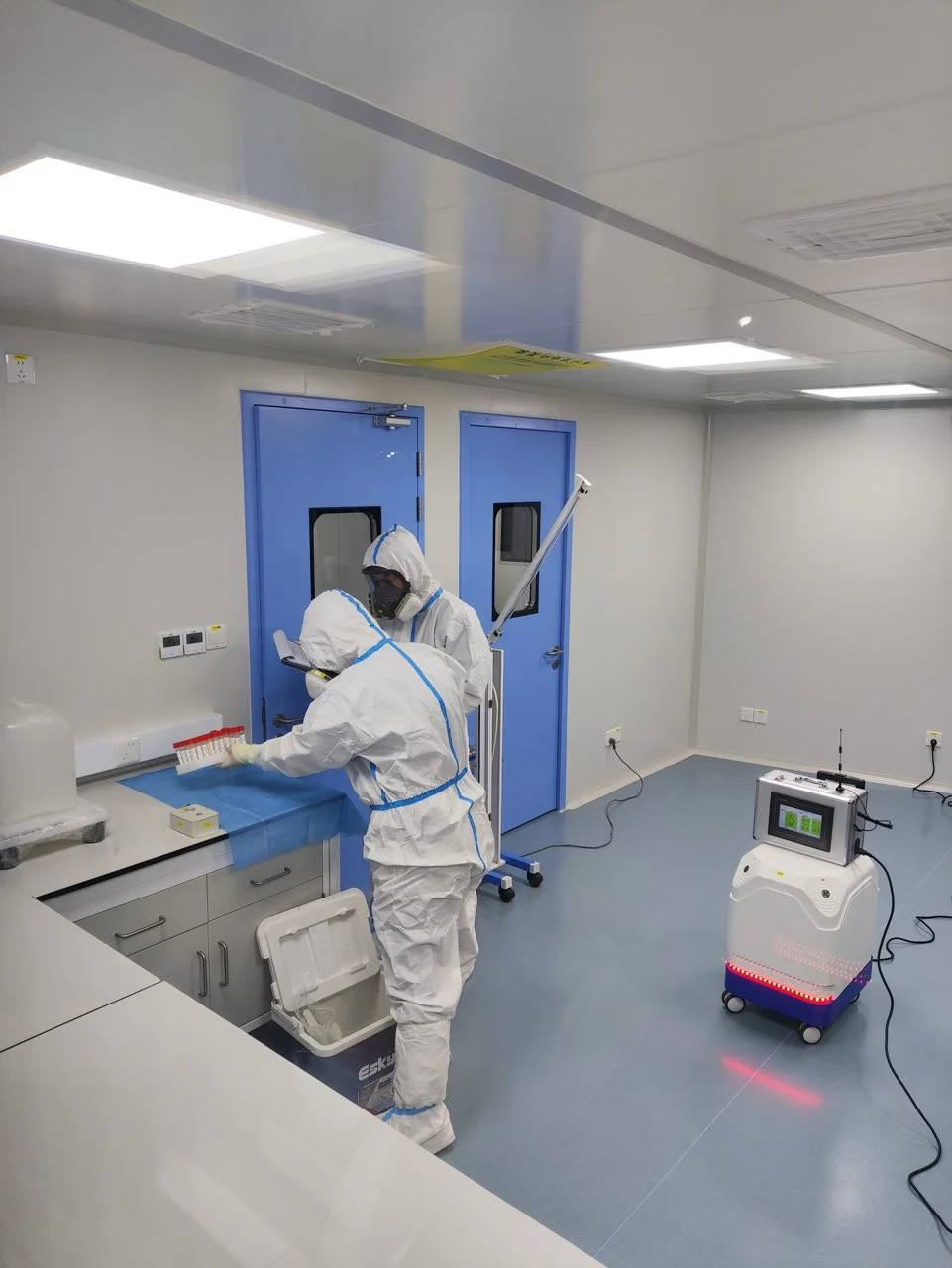
ON-SITE INVESTIGATION
We plan targeted sampling around the contamination history, site conditions and operating practices at your facility.
Site samples and observation records are considered alongside laboratory analysis to help investigate potential contamination sources and transmission routes.
Inside VanTsteri
VanTsteri's microbiology laboratory is part of the working environment behind our contamination-investigation services. We connect laboratory observations with the context of the customer's facility and the questions the project needs to answer.
A laboratory observation is one part of an investigation. Its significance depends on where and when it was recorded, the conditions at the site, and the information available from earlier monitoring or investigation work.
We bring these elements into the project discussion to help distinguish documented findings from possible explanations and identify questions that still need further assessment.
Photographed at VanTsteri's microbiology laboratory.
The initial review brings together the observation timeline, relevant facility or process information, and previous actions. Recent changes and recurring patterns are considered without automatically treating them as proof of a source.
Laboratory work, available records, and any external testing collaboration are discussed against the investigation questions. The required scope, responsibilities, and reporting arrangements are agreed for each project.
The investigation summary should explain what the evidence supports, what remains uncertain, and which follow-up actions merit discussion. These findings can inform subsequent contamination-control planning and on-site services.
Specific testing capabilities and report scope are confirmed for the project. These laboratory photographs do not represent results from a particular customer investigation.
Investigation scope
Review the reported issue, observation timeline, previous actions, and available records.
Consider the facility environment, relevant microbial characteristics, equipment, and operating changes.
Assess potential explanations, identify unresolved questions, and define useful next steps within the agreed scope.
Site investigation and testing collaboration are defined for the project, including responsibilities and available specialist support.
Contamination challenges
These topics help frame the initial discussion. Findings, possible sources, and required follow-up are assessed for the specific project.
Mycoplasma
Clarify the affected environment or equipment and the investigation required.
Mold
Discuss the history of the issue and how investigation can support the response.
Salmonella
Specify whether your concern involves the facility, equipment, or product.
Bacteriophage
Describe the actual industry, affected stage, and support needed.
OTHER MICROBIAL CONTAMINATION
Discuss other bacteria, yeasts, bacterial spores or unidentified contamination, together with the available laboratory findings and site observations.
What you receive
Observations and referenced information that support the investigation summary.
Potential sources, the evidence behind each assessment, and questions still requiring further work.
Practical recommendations for subsequent assessment or control measures, within the agreed scope.
Confirmed findings, potential explanations, and untested hypotheses remain clearly distinguished.
Related project experience
Browse related field references and discuss the investigation experience relevant to your application.
These links lead to available field references. Decontamination photographs do not by themselves establish investigation findings or confirmed contamination sources.
From investigation to action
Investigation findings can inform the proposed treatment scope, equipment selection, and on-site service requirements.
Explore On-Site Treatment Services →An investigation can be discussed as a separate engagement.
Where needed, discuss the next service scope based on the evidence available.
Explore KINO Equipment →People & responsibilities
Agree on investigation support, technical coordination, and deliverables.
Provide relevant records, site context, access coordination, and review requirements.
Where applicable, define the testing provider, work scope, reporting, and review responsibilities.
Prepare for the discussion
Dates, locations, findings, and prior actions, linked to existing records.
Monitoring results and previous investigation summaries available for review.
Relevant drawings, recent changes, and the contacts responsible for project review.
Detailed project documents can be shared after the initial contact and agreement on the exchange arrangements.
Common questions
No. A pattern should be recorded without treating it as a confirmed source. Its relationship to possible explanations requires investigation.
An investigation may identify supported sources, possible contributors, or remaining uncertainties. A unique cause is not guaranteed.
Describe the affected environment and observations. Any work involving cells, cultures, or products requires a separate and explicit scope.
The next steps depend on the available information and agreed scope. The initial discussion helps identify what further assessment is needed.
Yes. Investigation can be discussed independently of equipment procurement or on-site disinfection services.
Discuss your requirements
Start with the facility type, location, and a brief description of the issue. Detailed project information can be discussed with the team afterwards.
Investigation & Source Tracking — describe your contamination concern.
Submit this form to send us your enquiry. You can also contact us at inquiry@vantsteri.com. Please do not include confidential or sensitive information.
INTERNATIONAL PROJECT SUPPORT
VanTsteri supports international projects through shipment of remotely operated decontamination robots and remote technical support. On-site engineering support can be arranged according to project scope and commercial terms. Availability is assessed case by case, including shipping and customs, site readiness, connectivity and safe operating requirements.
Planning considers facility drawings, available microbial findings and site conditions. Equipment operation requires suitable site readiness, local coordination, connectivity and safe operating arrangements.