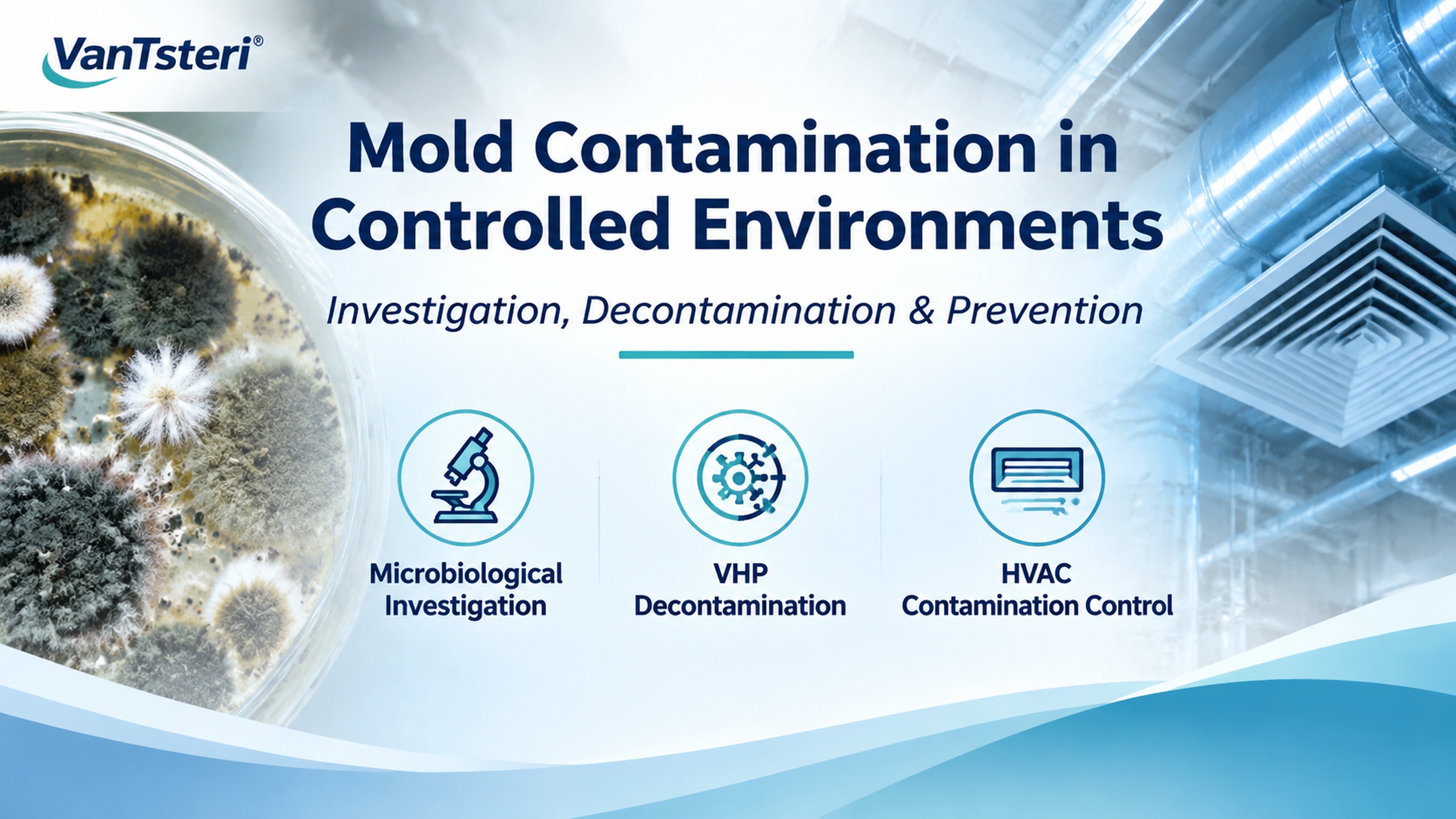
Introduction: Why Does Mold Contamination Keep Recurring in Pharmaceutical Cleanrooms?
Mold contamination is a challenging issue in environmental control within pharmaceutical manufacturing facilities.
Many pharmaceutical manufacturers face a similar situation: mold is detected during environmental monitoring, followed by cleaning and disinfection or even extensive terminal decontamination. Initial post-treatment results may appear satisfactory, but mold is detected again in the cleanroom after a period of time.
Why does mold contamination keep recurring?
Through its microbial contamination investigation and decontamination work at pharmaceutical and other manufacturing facilities, VanTsteri has found that recurring mold contamination cannot usually be attributed simply to an inadequate disinfection step. Disinfectant selection and application methods, identification of the contamination scope, facility structures, maintenance and construction activities, and post-treatment evaluation and follow-up monitoring can all affect the outcome of contamination control.
This article discusses five common reasons for recurring mold contamination, together with relevant investigation and control considerations based on VanTsteri's field experience.
1. Inappropriate Disinfectant Selection and Unvalidated Application Methods
During mold contamination investigations at pharmaceutical and other manufacturing facilities, VanTsteri frequently encounters an important problem: facilities use disinfectants without sufficient evidence demonstrating that the products are effective against mold spores. In addition, the actual application methods have often not been specifically validated.
Common situations include:
- No efficacy test reports demonstrating activity against relevant molds or mold spores.
- Supplier documentation focuses on general antibacterial activity or other microorganisms, without sufficient evidence of efficacy against mold spores.
- Disinfectant concentrations and contact times are selected based on routine practice, without confirming whether these conditions are suitable for mold spore control.
- Actual application methods have not been validated, so their effectiveness under real facility and use conditions has not been established.
As a result, a facility may carry out cleaning and disinfection routinely without establishing whether the selected disinfectant and its application method are suitable for the mold contamination problem.
A disinfectant's activity against general microorganisms does not automatically demonstrate its effectiveness against mold spores. Likewise, efficacy data for a disinfectant product do not, by themselves, establish that the actual application method used in a facility is effective.
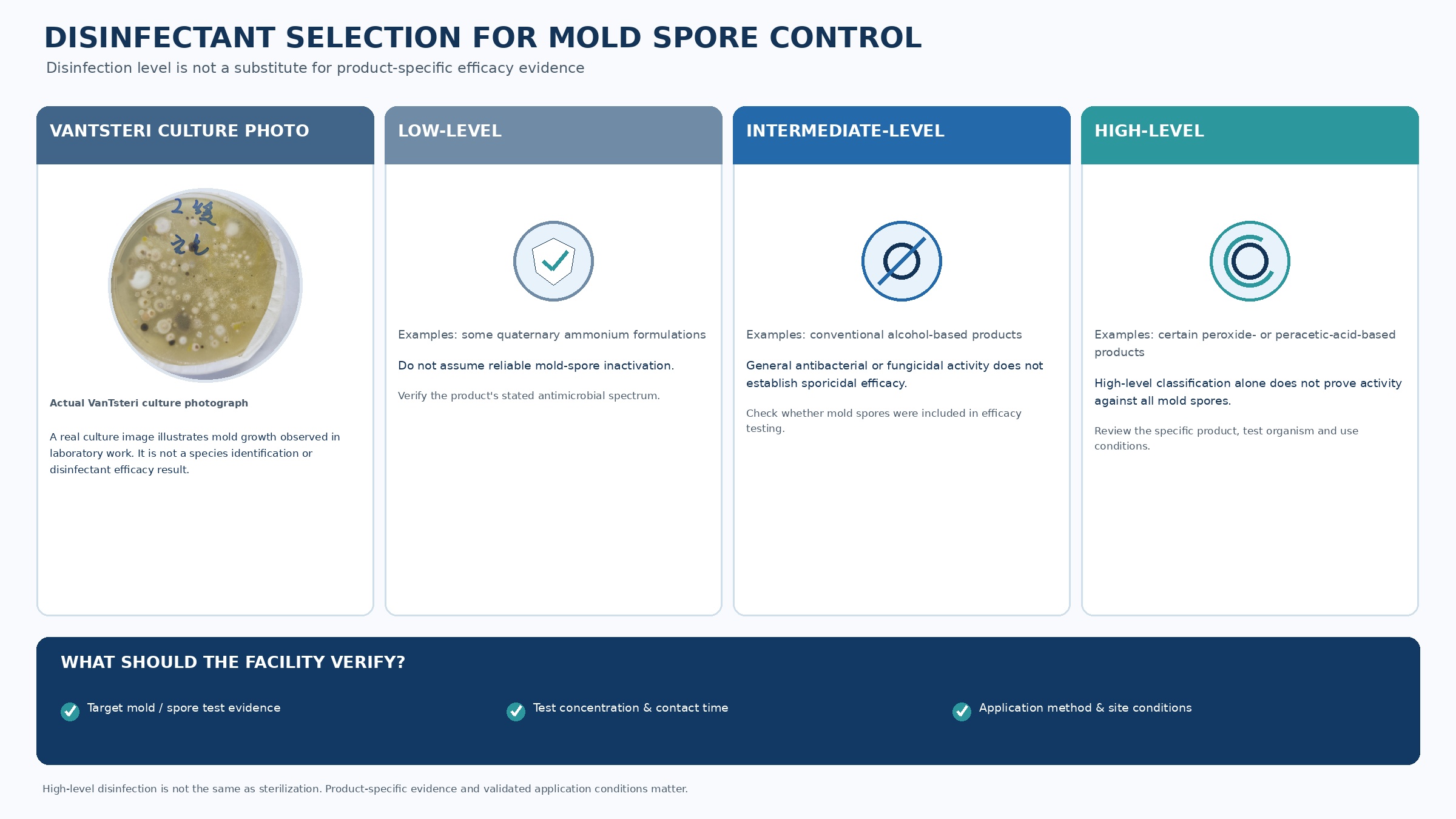
1.1 Different Disinfectants Have Different Levels of Activity Against Mold Spores
Disinfectants differ in their antimicrobial activity. When selecting a disinfectant for mold control, it is important to distinguish general antibacterial activity, fungicidal activity and demonstrated efficacy against mold spores.
Disinfectants are traditionally classified into low-, intermediate- and high-level categories. However, this classification does not directly establish the ability of a specific product to inactivate all mold spores.
High-level disinfection is not the same as sterilization. A high-level disinfectant should not automatically be assumed to inactivate all mold spores. Mold spores and bacterial endospores are different biological structures; efficacy data against bacterial endospores cannot directly replace evidence of efficacy against mold spores.
1.2 Disinfectant Concentration and Contact Time Matter
Even when a disinfectant has demonstrated relevant activity against mold spores, this does not mean that it will achieve the expected result under all conditions of use. Actual performance depends on factors such as concentration, contact time, target microorganisms, treated surfaces, environmental conditions and application method.
A manufacturer's mold spore efficacy report may be based on a specific concentration, contact time and set of test conditions. If the conditions used by a facility differ from those in the test, the report cannot automatically be taken as evidence of effectiveness under the actual application conditions.
Facilities should therefore confirm the working concentration, contact time, whether the target mold is covered by the available test evidence, whether the tested surfaces and application method are relevant, and whether site conditions such as temperature and humidity may affect performance.
1.3 Verify the Efficacy Evidence for Mold Spore Inactivation
VanTsteri recommends that facilities request relevant efficacy test reports from disinfectant manufacturers when selecting products for mold contamination control. Product brochures, general antimicrobial claims or disinfection-level classifications alone are not sufficient to establish suitability.
During site investigations, VanTsteri considers the target microorganisms, supporting efficacy data, test conditions, working concentration and contact time, and whether these conditions are appropriate for the actual application method. These factors are then assessed alongside contamination locations, facility configuration, material compatibility and treatment objectives.
2. Treating Only Mold-Positive Rooms and Relying on a Single Negative Test Result
During on-site investigations, VanTsteri frequently encounters situations where a facility detects mold in one cleanroom and carries out cleaning and disinfection only in that room, without further investigating adjacent rooms, HVAC systems, equipment interiors or other related areas.
After treatment, the facility performs environmental sampling. If no mold is detected in that sampling round, the facility may consider the problem resolved and discontinue further treatment and monitoring. However, mold may be detected again in the same room or other related areas just a few days later.
This illustrates why treating only the room with a positive finding does not necessarily resolve the wider contamination problem.
2.1 Why Localized Treatment May Not Resolve the Wider Contamination Problem
Mold contamination may involve multiple interconnected areas. A positive finding in one room does not mean that contamination is limited to that room, and the location where mold is detected is not necessarily the original contamination source. Positive findings may appear at return air outlets, equipment surfaces and production areas at different times. Treating only the positive room without assessing the HVAC system and other facility areas may leave related contamination locations unaddressed.
Without considering facility layout, airflow arrangements, equipment structures and microbiological findings together, localized treatment may not resolve contamination that persists elsewhere.
2.2 Why a Single Negative Sampling Result Does Not Demonstrate That Contamination Has Been Resolved
Mold distribution may vary over time and under different environmental conditions. Sampling results from air, surfaces and equipment-related areas are also influenced by sampling locations, methods, sampled area or volume, and testing conditions.
- A negative air sample does not establish that equipment surfaces or concealed areas are free from mold.
- A negative surface sample does not establish that other unsampled locations are free from contamination.
- A negative result from one sampling event does not establish that mold will remain undetected several days later or under changed facility operating conditions.
- Negative results from a limited number of sampling locations cannot represent the microbiological status of an entire cleanroom or facility.
A single negative sampling result indicates only that the target mold was not detected at the sampled locations under the specific sampling conditions and test method used. It does not, by itself, demonstrate that contamination has been eliminated throughout the facility.
2.3 Limitations of Mold Sampling and Detection Methods
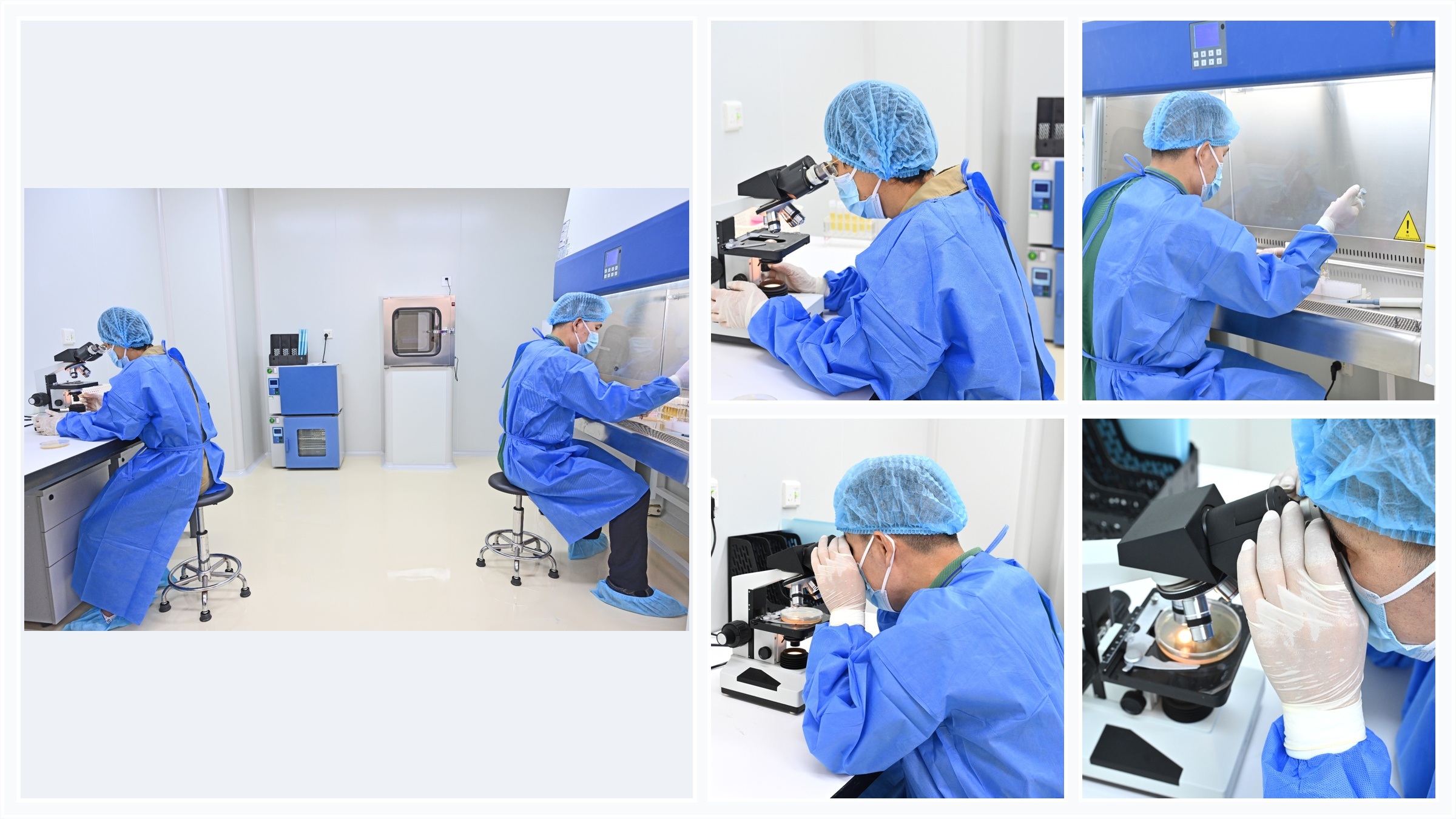
Different microbiological sampling and testing methods provide information about microorganisms recovered under different conditions. Common approaches include active air sampling, settle plate sampling, surface contact plate sampling, surface swab sampling, and targeted sampling of equipment and specific facility locations.
These methods differ in sampling scope, sample quantity or area, microbial recovery efficiency and detection capability. Culture-based methods are also influenced by factors such as culture media, incubation conditions, incubation time and the growth characteristics of the target microorganisms.
Consequently, the mold contamination status of an entire facility cannot be fully characterized using only one sampling method or a limited number of sampling locations. For recurring mold contamination, sampling plans should be developed according to the contamination characteristics, facility configuration and investigation objectives. Where appropriate, multiple sampling methods and results from different sampling events should be considered together.
2.4 From Localized Disinfection to Facility-Wide Contamination Assessment
For recurring mold contamination, VanTsteri recommends looking beyond the rooms where positive findings have been reported and assessing the wider facility and its operating conditions.
- Review historical microbiological results from different rooms, equipment and facility areas.
- Analyze the locations and timing of recurring positive findings.
- Assess potential relationships involving HVAC systems, equipment structures and facility layout.
- Identify concealed areas and potential contamination reservoirs requiring further investigation.
- Define an appropriate treatment scope based on the investigation findings.
- Establish post-treatment sampling and effectiveness evaluation plans that correspond to the project objectives.
Effective mold control is not simply a matter of treating each room with a positive finding or stopping after one negative sampling result. It requires a systematic assessment of contamination distribution, an appropriate treatment scope and evidence-based evaluation of the results.
3. Hidden and Complex Facility Structures Can Prevent Adequate Decontamination
In pharmaceutical cleanrooms and other manufacturing facilities, mold contamination is not necessarily limited to surfaces that can be reached through routine cleaning. Some equipment and facility structures are complex and may contain areas that are difficult for cleaning personnel to access, surfaces that cannot be reached through routine wiping, or locations that are difficult for the treatment medium to reach adequately.
- Internal HVAC ductwork and connection interfaces
- Cooling coils, condensate drain pans and related components inside air handling units
- Internal equipment spaces, structural cavities and sealed interfaces
- Ceiling voids, wall interfaces and other concealed building spaces
- Gaps between equipment, floors and walls
- Areas subject to persistent moisture or condensate accumulation
Where mold contamination is present in these locations and existing cleaning or disinfection methods cannot adequately address them, they may become potential reservoirs that allow contamination to persist. Complex structures do not automatically indicate the presence of mold; actual contamination must be assessed through site inspection and appropriate microbiological evidence.
3.1 Why Routine Cleaning and Disinfection May Not Adequately Cover These Areas
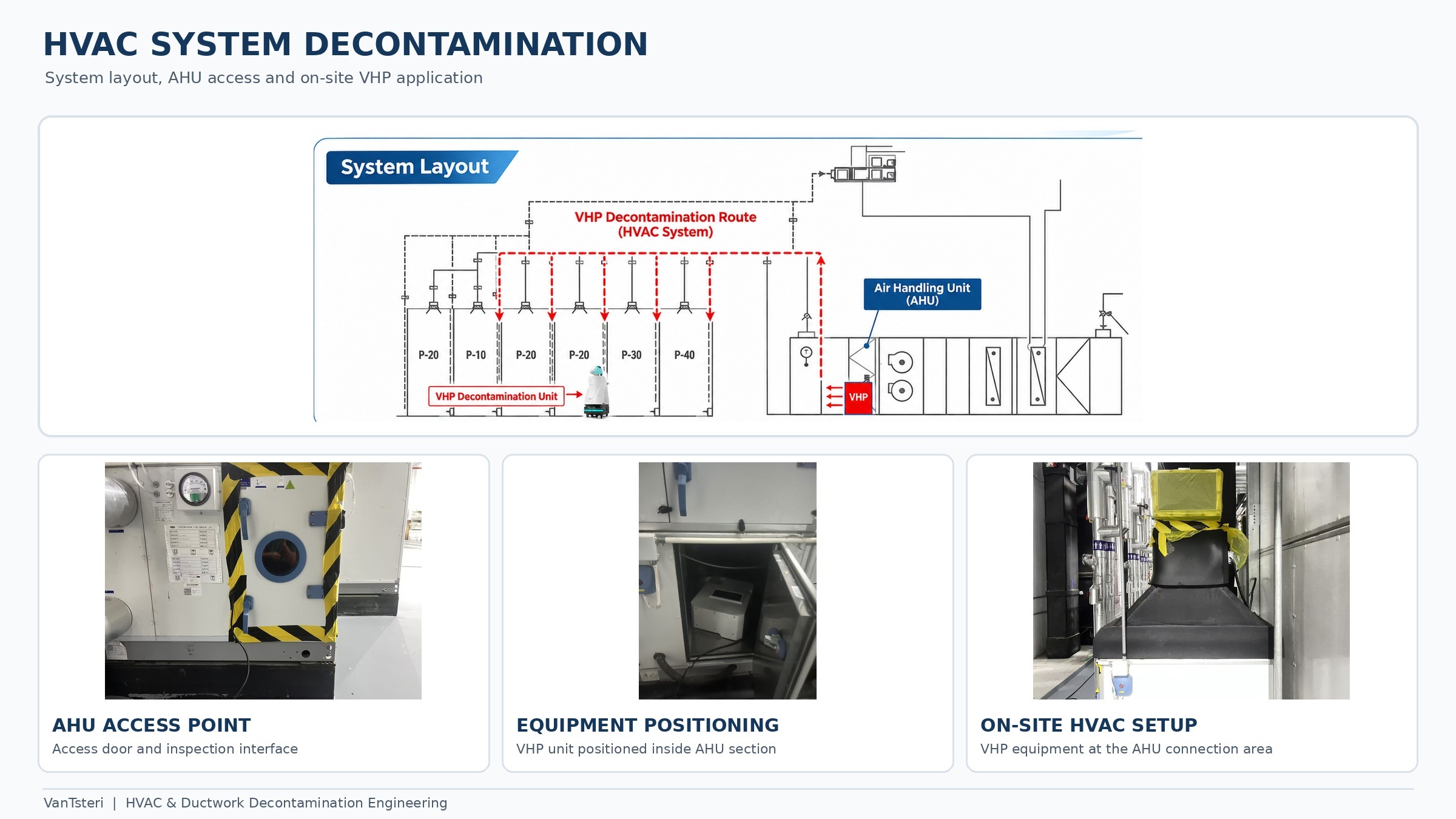
Limited cleaning accessibility: Routine cleaning generally focuses on accessible surfaces. Internal equipment spaces, ductwork, structural cavities and complex interfaces may be difficult to access or adequately clean through manual procedures. Cleaning the external surfaces of equipment does not establish that its internal structures have also been effectively addressed.
Incomplete treatment coverage: A disinfectant's demonstrated antimicrobial efficacy does not mean that it will automatically reach every contamination location during actual application. Manual wiping, spraying, spatial gas treatment and treatment of internal equipment spaces differ in their coverage and suitability. If the treatment medium does not adequately reach contaminated locations, the intended result may not be achieved, even when the selected disinfectant has demonstrated relevant efficacy.
Facility design and material compatibility constraints: Different equipment and facility structures have different materials, configurations and operating conditions. A treatment method suitable for selected room surfaces may not necessarily be appropriate for equipment interiors, areas near electronic components or other specialized structures. For porous, moisture-affected or damaged materials, surface disinfection alone may also be insufficient.
3.2 VHP Gas Decontamination: Reaching Complex and Hard-to-Access Areas
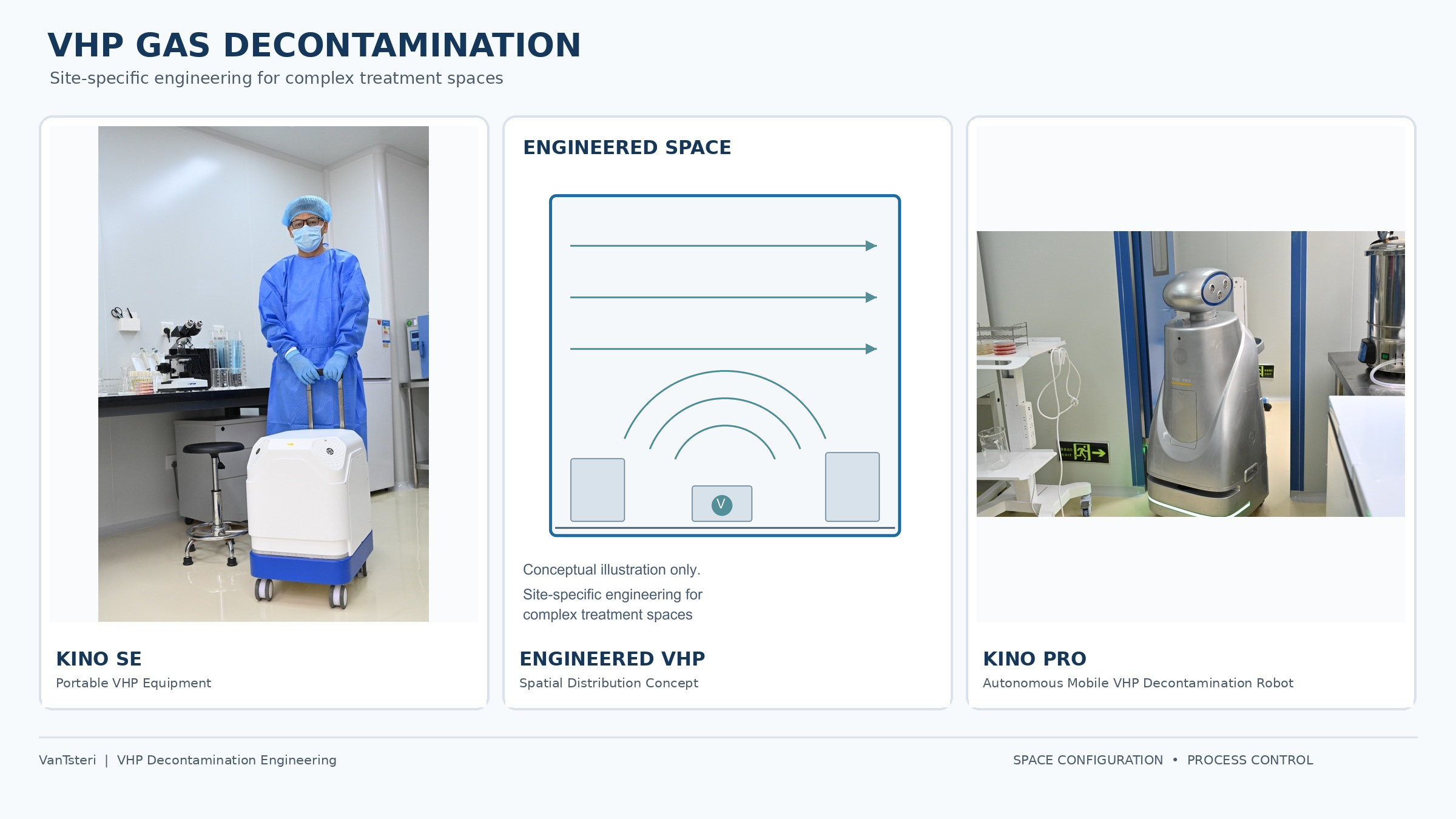
One important advantage of Vaporized Hydrogen Peroxide (VHP) decontamination is its ability to disperse as a gas throughout an appropriately enclosed and controlled space.
Unlike conventional disinfection methods that primarily rely on manual wiping or localized spraying, VHP can distribute throughout the treatment space and reach many surfaces and spatial locations that are difficult to access using conventional cleaning methods. With appropriate engineering design and process control, VHP can provide comprehensive spatial coverage and significantly reduce potential treatment blind spots in complex facilities.
For pharmaceutical cleanrooms and manufacturing environments, this is particularly valuable when contamination concerns involve equipment interiors, structural interfaces, enclosed spaces and other locations that are difficult to reach through routine cleaning.
VanTsteri integrates VHP technology with site-specific engineering to develop decontamination solutions based on the actual facility configuration.
VanTsteri's engineering assessment considers:
- Facility layout: room dimensions, spatial configuration and interconnected areas.
- Equipment distribution: equipment arrangement, internal spaces and potential obstructions to gas distribution.
- Space enclosure: enclosure integrity and conditions affecting treatment distribution.
- Material compatibility: compatibility of hydrogen peroxide with facility structures, equipment and relevant materials.
- Treatment process: project-specific treatment conditions, process monitoring and control.
- Effectiveness evaluation: appropriate evidence and assessment methods to evaluate treatment results.
VHP treatment is not simply a matter of placing a generator inside a room. The treatment approach must be engineered according to the space, equipment configuration, material characteristics and project objectives.
By combining gas-phase distribution with site-specific engineering, VanTsteri aims to achieve more comprehensive treatment coverage and reduce areas that may be missed by conventional localized disinfection methods.
VHP does not replace necessary physical cleaning, moisture correction, equipment maintenance or repair. Actual treatment coverage and effectiveness must be evaluated under the specific facility and process conditions.
3.3 How VanTsteri Addresses Mold Contamination in Complex Facilities
For mold contamination involving complex facility structures, VanTsteri first assesses the relationship between the affected areas and the facility configuration before determining an appropriate treatment approach. The engineering assessment may include facility structure assessment, treatment accessibility assessment, integrated decontamination planning, engineering implementation and effectiveness evaluation.
VanTsteri does not rely on a predetermined disinfection procedure for every facility. Our approach is developed according to the actual facility configuration and contamination characteristics.
Selecting an effective disinfectant does not guarantee that all contamination locations will be adequately treated. Effective decontamination requires consideration of disinfectant efficacy, treatment accessibility and facility configuration.
4. Mold Contamination Associated with Maintenance, Construction and Facility Repair Activities
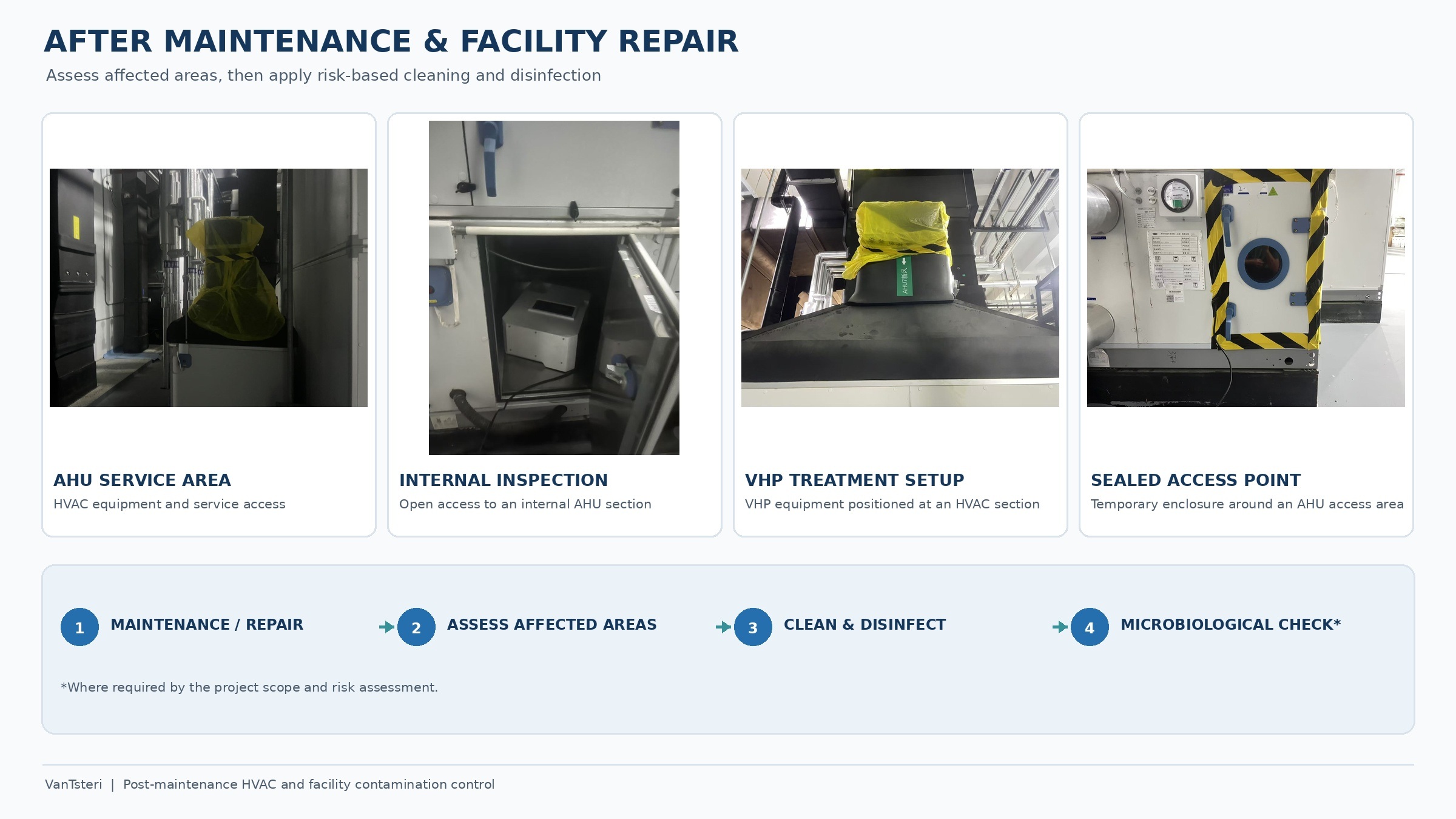
During mold contamination investigations in pharmaceutical cleanrooms, VanTsteri has identified equipment maintenance, facility repairs and construction activities as important mold contamination risk factors.
Based on VanTsteri's field experience, more than 50% of the mold contamination cases encountered in our projects have involved risks associated with these types of activities. This figure reflects observations from VanTsteri's field projects; it is not an industry-wide statistic and does not mean that these activities have been confirmed as the direct cause in every case.
Although pharmaceutical cleanrooms generally operate under strict controls for personnel access, material transfer and routine production activities, equipment servicing, ductwork maintenance, filter replacement, building repairs and localized construction can change existing facility conditions and introduce new microbial contamination risks.
- Equipment maintenance: disassembly, servicing and reinstallation may expose internal areas that were previously enclosed or difficult to access.
- HVAC maintenance: ductwork servicing, filter replacement, cooling coil maintenance and condensate system repairs may affect the existing microbial control conditions of the system.
- Building and facility repairs: repairs to walls, ceilings, floors and wall penetrations may generate dust and expose previously concealed areas.
- Localized construction: drilling, cutting, installation and other construction activities may disturb established cleanroom environmental controls.
- Maintenance tools and equipment: external maintenance tools, temporary equipment and replacement components may introduce new contamination risks.
Completion of maintenance or construction does not automatically mean that the affected area has returned to its previous microbiological control state. If contamination is introduced during these activities and appropriate cleaning and disinfection measures are not implemented afterwards, mold may be detected again when production resumes.
VanTsteri recommends that, after maintenance, facility repairs and construction activities, appropriate cleaning and disinfection be carried out in affected areas, equipment and related facilities according to the scope of work and associated contamination risks. Where necessary, microbiological testing should also be conducted to assess whether the affected areas meet the requirements for returning to operation.
5. Inadequate Effectiveness Evaluation and Follow-up Monitoring
During on-site projects, VanTsteri encounters situations where facilities rely mainly on a limited number of environmental samples to determine whether mold decontamination has been successful. If no mold is detected in that sampling round, the facility may consider the problem resolved and resume normal production.
However, this conclusion may go beyond what the actual test results can support. A post-treatment sampling result reflects the microbiological conditions at specific locations, at a particular time and under the sampling and testing methods used. It does not automatically demonstrate that mold contamination has been eliminated throughout the facility or that contamination will not recur during subsequent operations.
An effective assessment should consider the treatment objectives, treatment scope, available process records, sampling plan, testing methods and predefined acceptance criteria.
5.1 Pre-treatment Assessment: Define the Contamination Status and Evaluation Objectives
Before decontamination, the existing mold contamination should be reviewed to establish the treatment scope and evaluation objectives. Relevant information may include existing positive locations and contamination distribution, available mold identification and environmental monitoring results, rooms and equipment requiring treatment, target microorganisms, the proposed treatment approach, and planned post-treatment sampling and assessment methods.
Pre-treatment findings can provide a reference for subsequent evaluation. If baseline data are unavailable, a post-treatment assessment can still be developed according to project conditions, but a reduction in microbial levels should not be claimed without supporting comparative evidence.
5.2 During Treatment: Review the Process and Applicable Evidence
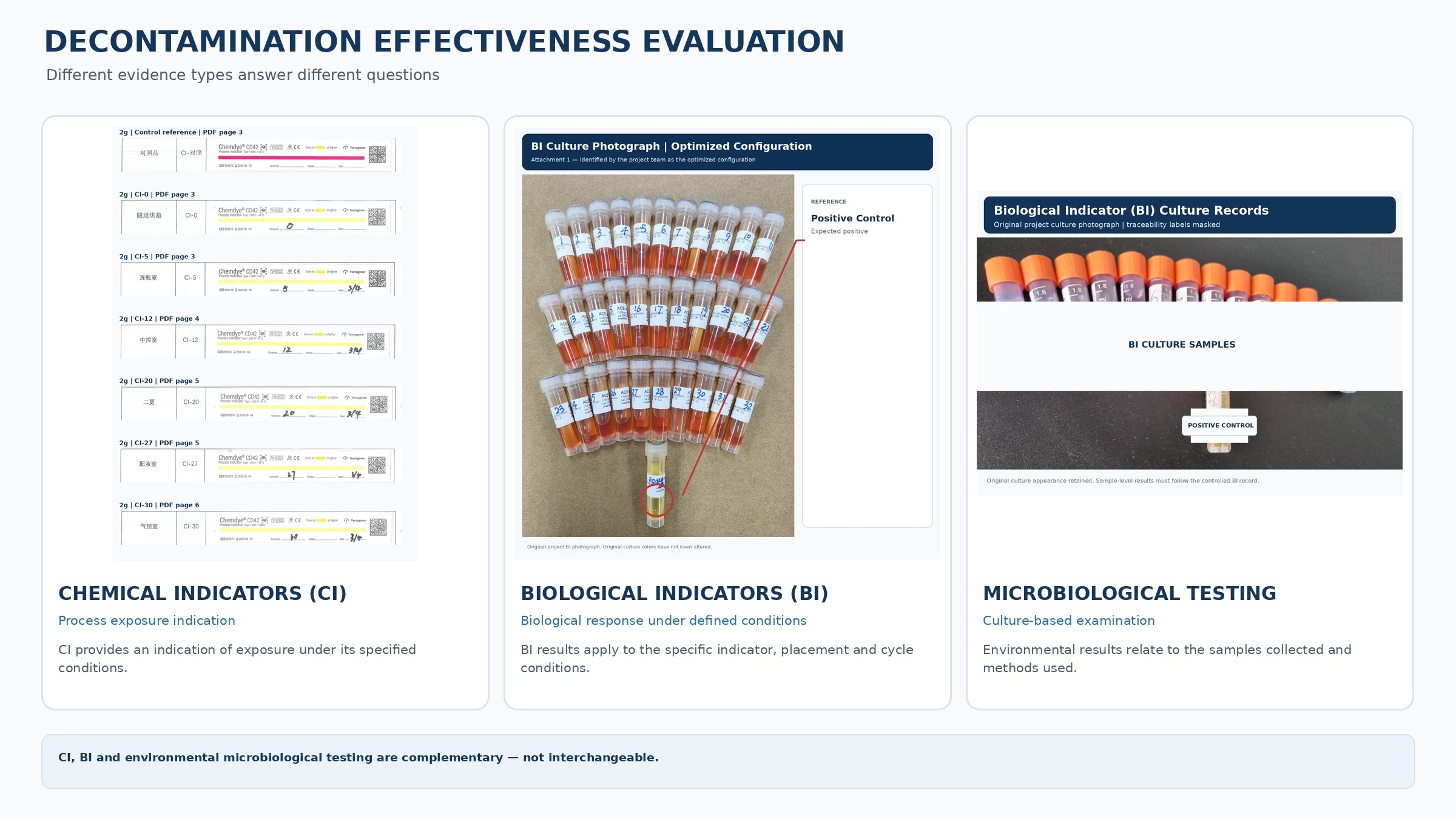
During decontamination, relevant process records and assessment evidence should be retained according to the treatment technology and agreed project requirements. Depending on the project, these may include disinfectant concentration and contact-time records, VHP process-monitoring records, chemical indicator (CI) results, biological indicator (BI) results and other assessment records applicable to the selected treatment method.
Chemical indicators provide information about the response of the indicator under specified conditions. Biological indicators assess the biological response of specific indicators under defined treatment conditions. These methods are not interchangeable, and neither should be interpreted alone as proof of equivalent treatment effectiveness throughout an entire facility.
5.3 Post-treatment: Microbiological Testing and Result Evaluation
After decontamination, appropriate microbiological sampling and testing methods should be selected according to the project objectives and assessment scope. For mold contamination in pharmaceutical cleanrooms, the assessment may include active air sampling, settle plate sampling, surface contact plate sampling, surface swab sampling, and targeted sampling of equipment and relevant facility locations.
Results should be interpreted in relation to the actual sampling locations, sample quantities, sampling times, sampling methods and testing methods. Where pre-treatment data are available, changes may be assessed when sampling and testing conditions are sufficiently comparable. Where baseline data are unavailable, post-treatment findings should be interpreted against the predefined assessment objectives and acceptance criteria.
The absence of detected mold in the samples tested indicates only that mold was not detected under the specific sampling and testing conditions. It does not establish that the entire facility is free from mold.
5.4 Why Follow-up Monitoring Matters After Production Resumes
Mold control should not focus only on the results obtained immediately after treatment. Microbiological conditions should also be considered after the facility returns to operation. This is particularly relevant for areas that have undergone equipment maintenance, facility modifications, HVAC servicing or other construction activities. Appropriate follow-up monitoring should be considered according to the associated risks and project requirements.
Follow-up monitoring can help assess whether mold reappears at previously positive locations, whether identified contributing factors have been addressed, whether equipment and facility operating conditions have changed, whether environmental monitoring identifies new concerns, and whether further contamination investigation is necessary.
If mold is detected again after production resumes, the new findings and relevant operating records should be reviewed to reassess potential contamination sources and reintroduction routes. VanTsteri recommends connecting decontamination, post-treatment effectiveness evaluation and follow-up assessment after production resumes as part of a continuous contamination control approach.
5.5 Independent and Project-Based Effectiveness Evaluation
VanTsteri provides effectiveness evaluation and verification in two service modes.
Independent Effectiveness Evaluation: Customers who have already completed decontamination through their own teams or other service providers can separately enquire about an assessment of the completed treatment.
Project-Based Effectiveness Evaluation: Effectiveness evaluation can also be included in VanTsteri's contamination investigation and on-site microbial decontamination projects.
In both cases, the evaluation scope, sampling requirements, methods and acceptance criteria are defined according to the treatment objectives, available records and facility conditions.
6. How VanTsteri Supports Pharmaceutical Facilities with Integrated Mold Contamination Control
For recurring mold contamination in pharmaceutical cleanrooms, VanTsteri brings together microbiological testing, contamination investigation, facility assessment, on-site decontamination engineering and effectiveness evaluation.
6.1 Microbiological Testing and Contamination Investigation
Air, surface and relevant equipment or facility sampling can be combined with cultivation, microbial identification and review of available environmental monitoring data to assess mold distribution and changing patterns.
6.2 Contamination Source and Facility Assessment
Contamination history, facility layout, HVAC systems, equipment structures, moisture conditions and production activities are considered when assessing potential contamination sources and pathways.
6.3 Integrated Decontamination Engineering
Cleaning, localized treatment, VHP or other applicable technologies are selected according to the target microorganisms, contamination locations, disinfectant efficacy evidence, material compatibility and facility conditions.
6.4 Effectiveness Evaluation and Follow-up
The evaluation scope, sampling requirements, testing methods and acceptance criteria are defined according to project objectives. VanTsteri can provide effectiveness evaluation within its own decontamination projects or separately assess treatments completed by customers or other service providers.
The specific service scope and implementation arrangements are determined according to project conditions.
7. Frequently Asked Questions
Q1. Why does mold keep being detected in a cleanroom even when disinfectants are used?
Possible reasons include insufficient evidence of efficacy against mold spores, unvalidated application methods, incomplete identification of the contamination scope, inadequate treatment of concealed areas, or reintroduction following maintenance and construction activities. The situation should be investigated using microbiological findings and facility information.
Q2. Can alcohol kill mold spores?
Conventional alcohol-based disinfectants generally should not be relied upon as sporicidal treatments for mold spores. Suitability should be assessed using product-specific efficacy data.
Q3. How can a facility determine whether a disinfectant is suitable for mold control?
Review efficacy reports for the target mold or relevant representative test organisms, including the test method, concentration, contact time and test conditions. Assess whether these conditions are applicable to the actual use.
Q4. Can VHP solve every mold contamination problem?
No. VHP requires engineering assessment in relation to facility configuration, material compatibility, contamination locations and project objectives. Persistent moisture, structural defects or contamination reservoirs may also require cleaning, repair or other corrective measures.
Q5. If no mold is detected after treatment, does that mean the entire cleanroom is mold-free?
No. Results apply to the samples collected and the methods used. They should be interpreted in relation to the treatment objectives, assessment scope, sampling locations and follow-up monitoring.
8. Discuss Your Pharmaceutical Cleanroom Mold Contamination Challenge with VanTsteri
Recurring mold contamination in pharmaceutical cleanrooms is rarely resolved by a single disinfection step.
From disinfectant efficacy and contamination source investigation to facility assessment, integrated decontamination engineering and post-treatment effectiveness evaluation, each stage can influence the final contamination control outcome.
VanTsteri provides microbial contamination investigation, on-site decontamination engineering and effectiveness evaluation services for pharmaceutical manufacturing environments.
If mold continues to be detected in your cleanroom after cleaning and disinfection, you can share information about the affected areas, contamination history, available microbiological results, disinfectants and application methods currently used, facility layout and HVAC systems, as well as previous treatment records and follow-up monitoring results.
VanTsteri can review the available information with you and discuss an appropriate investigation scope and technical approach.