VanTsteri’s technical article discusses mold contamination in pharmaceutical clean areas and the difficulty of addressing organisms present in air, on surfaces and in less accessible locations.
Evaluate VHP as one option
The source describes vaporized hydrogen peroxide equipment as an option for treating room environments and surfaces. The proposed approach includes equipment deployment and biological and chemical indicators to assess treatment.
Require application-specific evidence
The article does not supply a single-project dataset establishing a universal kill rate, toxin removal or material compatibility. Treatment planning should therefore define the organisms, exposure conditions, affected materials and acceptance criteria before interpreting the results.
Pharmaceutical HVAC systems are part of the production environment’s contamination-control strategy. Whether and how a system needs decontamination should be assessed against the actual system, its operating conditions and the evidence available. VanTsteri supports this process from system assessment to treatment verification.
Start with the system and the evidence
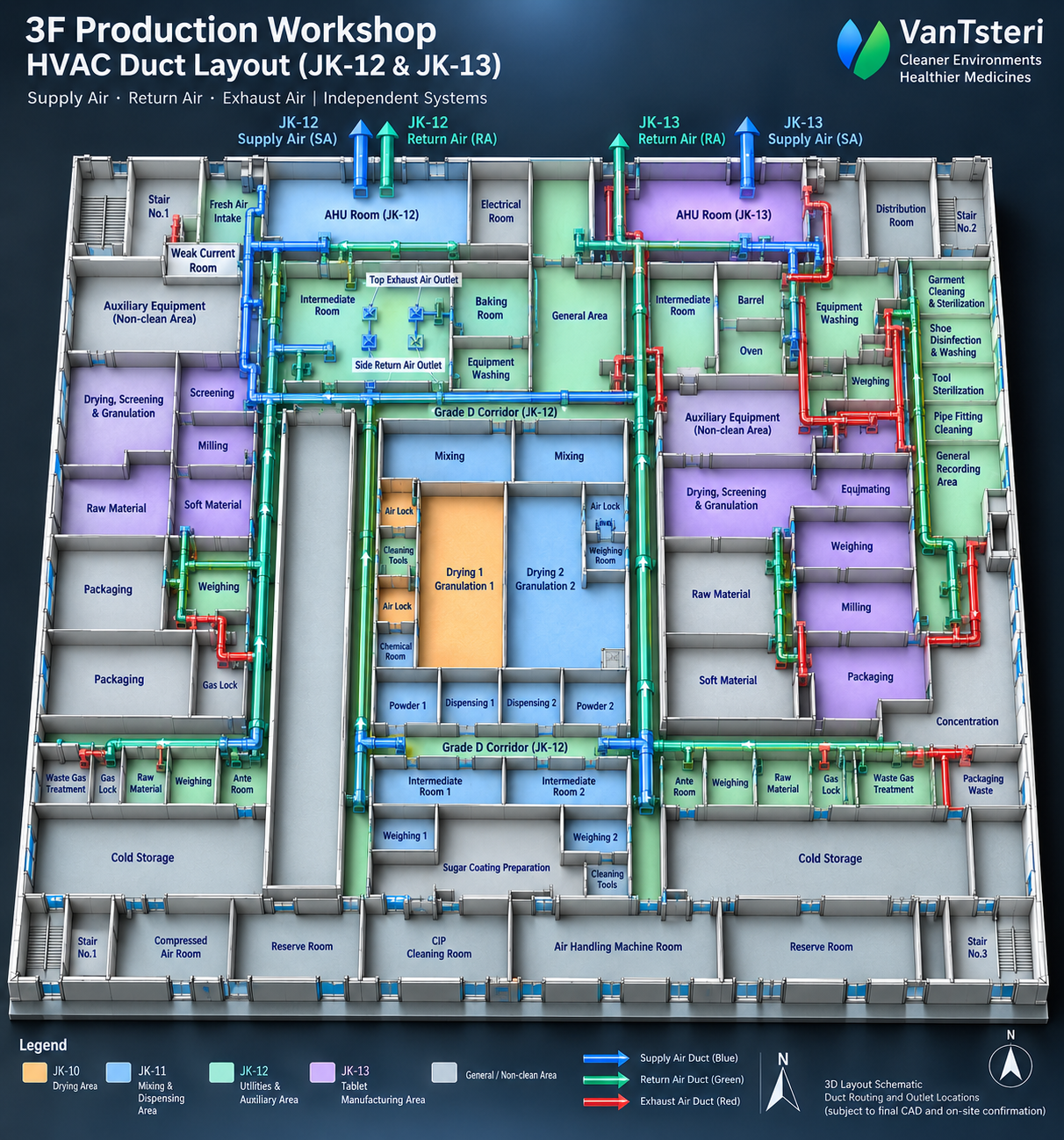
Assessment considers the air-handling unit, supply and return ducts, relevant exhaust paths and terminal components. Drawings, maintenance records, environmental monitoring trends and on-site observations help define the areas that need attention.
If abnormal microbial findings occur, the investigation should consider multiple possible sources and pathways. HVAC is a line of inquiry, not the assumed cause of every contamination event.
Address cleaning and defects separately from decontamination
Dust accumulation, standing water and system defects need their own assessment and corrective work. Decontamination does not replace cleaning or repair. The required work and its sequence should be defined for the site before a treatment plan is implemented.
Tailor VHP treatment to the HVAC system
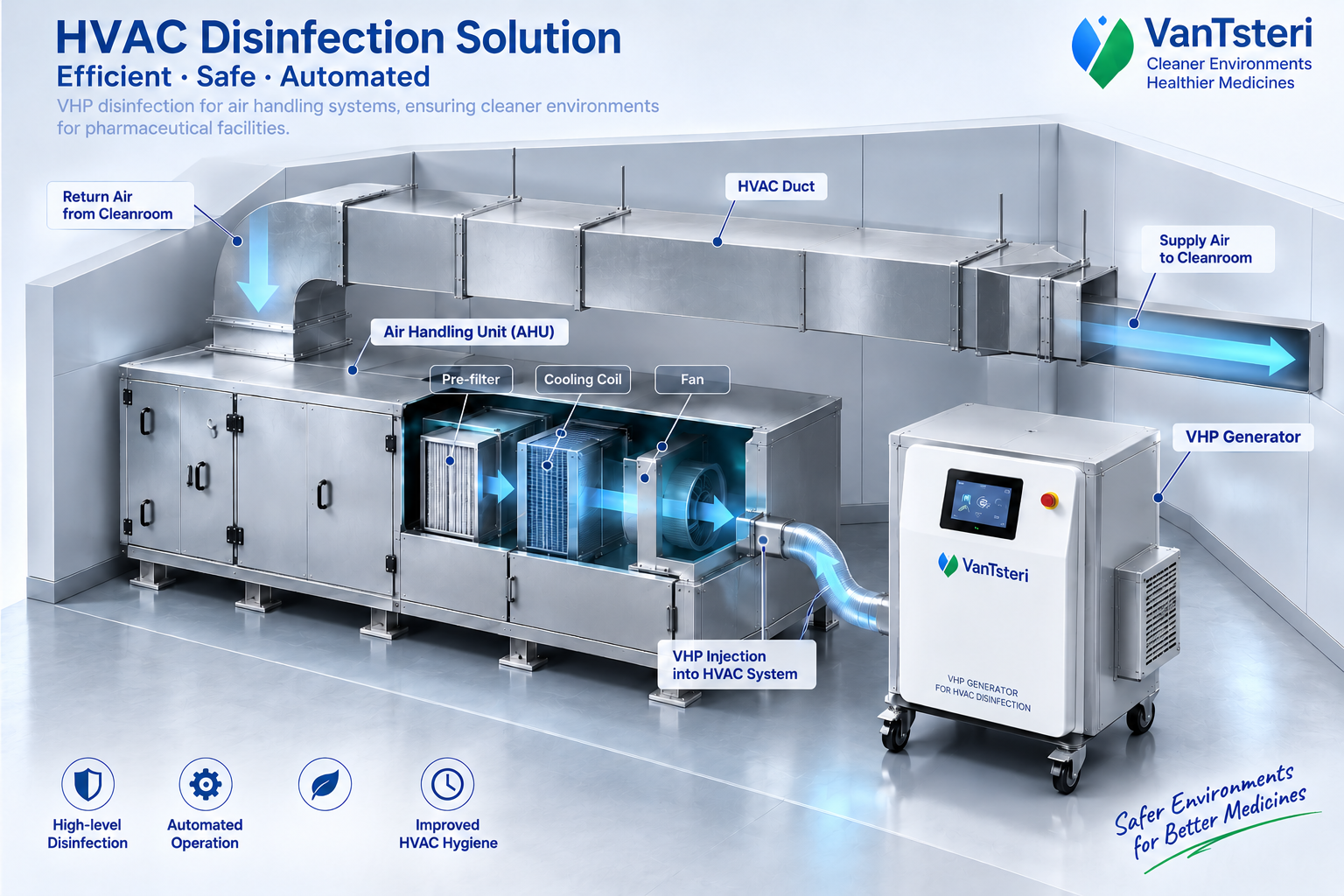
VanTsteri has dedicated HVAC decontamination equipment and develops vaporized hydrogen peroxide (VHP) duct-treatment plans around the customer’s system structure, zones and operating conditions.
Illustrative HVAC and VHP equipment arrangement.
Equipment selection, connection arrangements and operating feasibility are assessed before implementation and verification.
Planning considers system zoning and isolation, whether treatment can reach the intended branches, material compatibility, residual-agent clearance, personnel safety and the conditions for returning the system to use.
Related equipment can be discussed as part of a site assessment. Linking a product does not mean that it is suitable for every HVAC configuration.
The treatment scope, relevant conditions and verification approach should be defined for the actual system. Records support evaluation of the work performed and its outcome within that scope.
Where necessary, assessment also considers filter integrity, airflow performance and the effect on the production environment. A treatment claim should not be extended beyond the conditions and evidence that support it.
Set maintenance frequency according to risk
A maintenance and contamination-control programme should reflect the system’s use, condition, monitoring results and relevant changes or events. There is no single six-month or annual decontamination interval that this article prescribes for all pharmaceutical HVAC systems.
Connect system assessment with on-site support
VanTsteri’s pharmaceutical weighing and sampling room case provides a related example of coordinating room treatment with the associated ventilation system. It does not establish a universal treatment schedule for other facilities.
If you need to assess your pharmaceutical HVAC system, discuss system investigation, equipment suitability, a tailored treatment plan and verification requirements with VanTsteri.
This service application article draws on VanTsteri’s HVAC treatment discussion and guide commentary. It is not an account of a new customer project. Both images are illustrative; the equipment appearance, labels and routing do not establish a project’s equipment model, operating conditions, automation level or measured outcome.
VanTsteri’s technical article describes placing biological indicators at selected locations to evaluate a VHP treatment cycle. The challenge organism, population, resistance and exposure conditions are part of the interpretation.
Read the result within its scope
The source describes recovering and culturing indicators after treatment. An indicator result concerns the specified challenge and location; the nominal population of an indicator alone is not a measured log reduction across the whole facility.
Combine performance and suitability checks
The article also discusses usability, material compatibility, treatment distribution and residual-control considerations. These need project-specific evaluation. The source is an explanation of validation practices rather than a report of a single completed customer project.
VanTsteri’s source article comments on the second edition of a Chinese pharmaceutical GMP guide. It discusses contamination accumulation in ducts and the importance of considering cleanliness during installation and maintenance.
Plan access and maintain integrity
The commentary highlights protecting pre-cleaned equipment before installation, providing appropriate cleaning access and preserving system sealing. Treatment methods also need an assessment of duct and filter materials.
Use a justified maintenance plan
The article discusses periodic and event-driven maintenance, including investigation after contamination. Its suggested intervals are the author’s interpretation, not a universal legal schedule. The actual programme should follow the facility’s risk assessment and applicable requirements.
VanTsteri’s article compares formaldehyde fumigation, ozone, ultraviolet irradiation and vaporized hydrogen peroxide for pharmaceutical laboratory environments.
Consider operating conditions
The source discusses concentration, exposure duration, temperature and humidity for chemical approaches, and lamp output, distance and irradiation duration for ultraviolet treatment. These factors are presented as considerations rather than transferable operating recipes.
Include compatibility and verification
The comparison also addresses personnel exposure, material effects, residual clearance and treatment evaluation. VHP is discussed with chemical and biological indicators. Selection requires evidence for the intended environment; this article does not demonstrate that one method is universally superior.
VanTsteri’s source article discusses the distinction between environmental decontamination and terminal sterilization of products. It examines log reduction, starting bioburden and assurance concepts as different parts of treatment evaluation.
Understand the biological indicator
The article discusses organism selection, indicator population, carrier materials and resistance data. It also considers differences between supplier measurements and testing in the actual treatment system.
Evaluate the method and its limits
The source emphasizes that indicator population alone cannot define treatment performance. A validation assessment needs the challenge conditions, recovery method and intended use. The source’s differing numeric recommendations and historical guideline interpretations are not presented here as a universal acceptance standard.
VanTsteri’s source commentary discusses VHP in medical-device sterilization, pharmaceutical environments and isolator applications. These contexts involve different intended uses and should not be treated as one interchangeable regulatory framework.
Define the evidence package
The commentary addresses process parameters, biological challenges, material compatibility, residual control and ongoing monitoring. A project needs a documented interpretation of the requirements that actually apply to its equipment, process and market.
Check primary requirements
This is a company-authored regulatory discussion, not a certificate of compliance or a statement that every VHP room-treatment system meets device-sterilization requirements. Specific chapter references and numerical limits should be confirmed against authoritative current texts before being used as acceptance criteria.
VanTsteri’s technical note discusses four elements: VHP generation, robotic navigation, remote concentration monitoring and HVAC treatment. These are equipment and planning topics rather than a completed customer case.
Connect readings to the treatment scope
The note contrasts readings near the treatment device with monitoring at additional room locations. Monitoring arrangements should support interpretation of the conditions in the areas included in the treatment plan.
Verify the actual configuration
Navigation features, remote sensing and HVAC integration depend on the equipment configuration. Their presence alone does not establish uniform exposure or a microbiological outcome throughout a facility.
VanTsteri’s brief source note mentions a vaporized high-level disinfectant approach and dedicated duct-treatment equipment for operating-room HVAC. It contains no project description, operating conditions or measured results.
VanTsteri’s source article presents VHP as a technology that developed from laboratory work into applications in life sciences, pharmaceutical production, food processing and biosafety.
From equipment to validation
The article discusses equipment development, treatment optimization and the increasing role of validation and process documentation. It also looks toward intelligent equipment and traceable treatment records.
Keep historical claims in scope
The source contains a detailed historical timeline and regulatory references. Those dates, institutional applications and alleged endorsements are not treated here as independently verified history or as approval of a particular VanTsteri system. This overview provides no single customer-project result.