Category: Disinfection Knowledge

  • Planning Decontamination in High-Containment Laboratories

    Robotic VHP support for laboratory environments

    High-containment laboratories bring equipment, facilities and safety requirements together. VanTsteri offers vaporized hydrogen peroxide (VHP) decontamination services and robotic equipment support, with the application scope assessed against the laboratory’s requirements.

    Our service can bring design, implementation and verification into one coordinated project. Equipment selection and the intended results are reviewed with the laboratory’s safety and facilities teams.

    Two modes of robotic decontamination

    For site-validated tasks, autonomous operation allows the robot to carry out predefined work at designated locations. Repeatable task execution and operation records support project review.

    Remote manual driving allows an operator outside the treatment area to guide the robot to a designated location that requires attention. This can reduce the need for personnel entry while keeping the operator involved in the task.

    The robot does not independently decide how to respond to a laboratory event. Both modes remain subject to the laboratory’s safety management and site-specific assessment and validation.
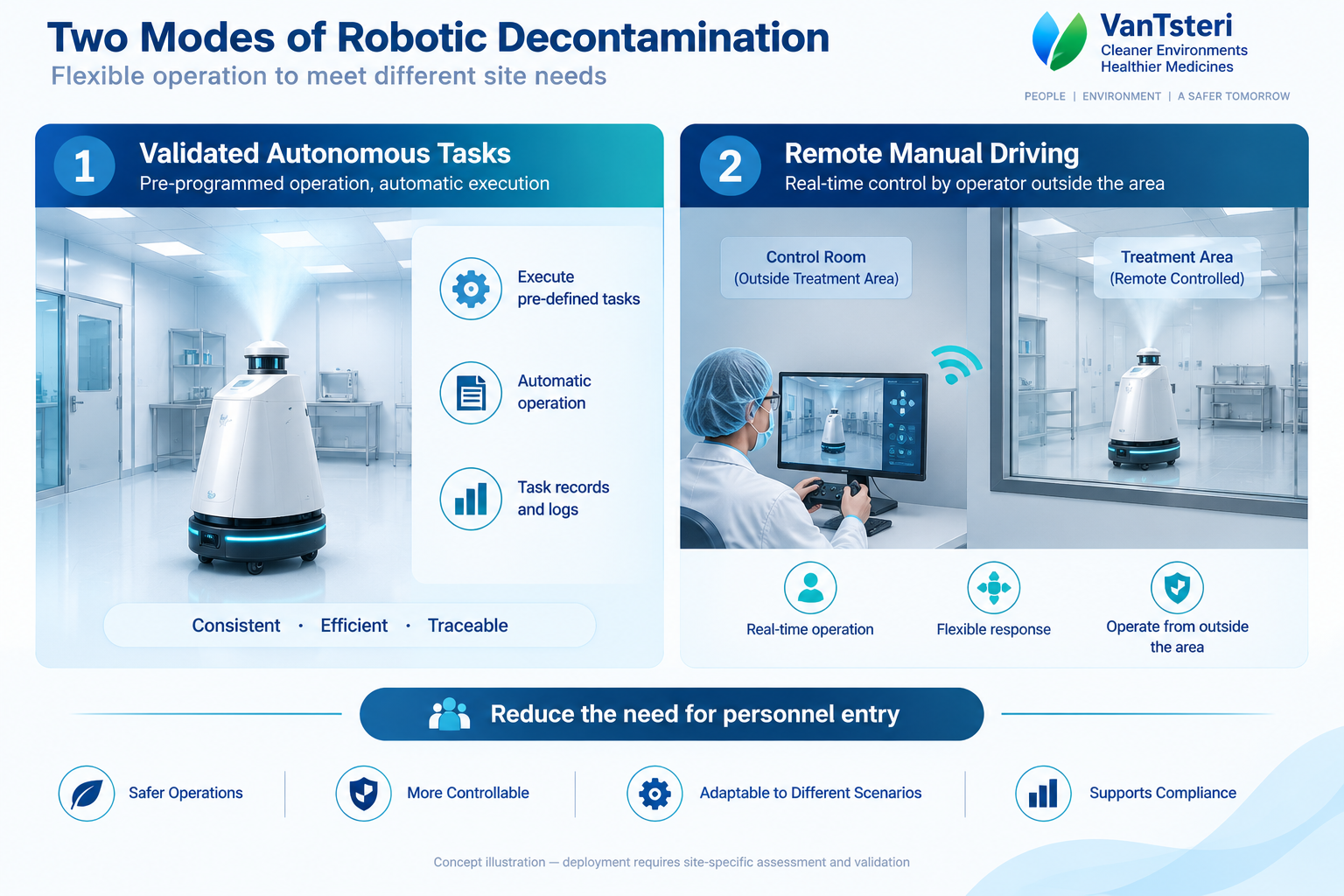
    Two modes of robotic decontamination: validated autonomous tasks and remote manual driving
    Concept illustration — deployment requires site-specific assessment and validation.

    Coordinate treatment with the facility

    VanTsteri describes HVAC-coordinated decontamination as an option that may be assessed for suitable negative-pressure laboratory environments. The laboratory’s safety and facilities teams evaluate the proposed scope, compatibility and verification requirements while maintaining the facility’s existing safety requirements.

    Suitability depends on the actual facility and project. A coordinated approach does not imply that every laboratory can continue operating during treatment or that the robot, HVAC system and facility have already been validated together.
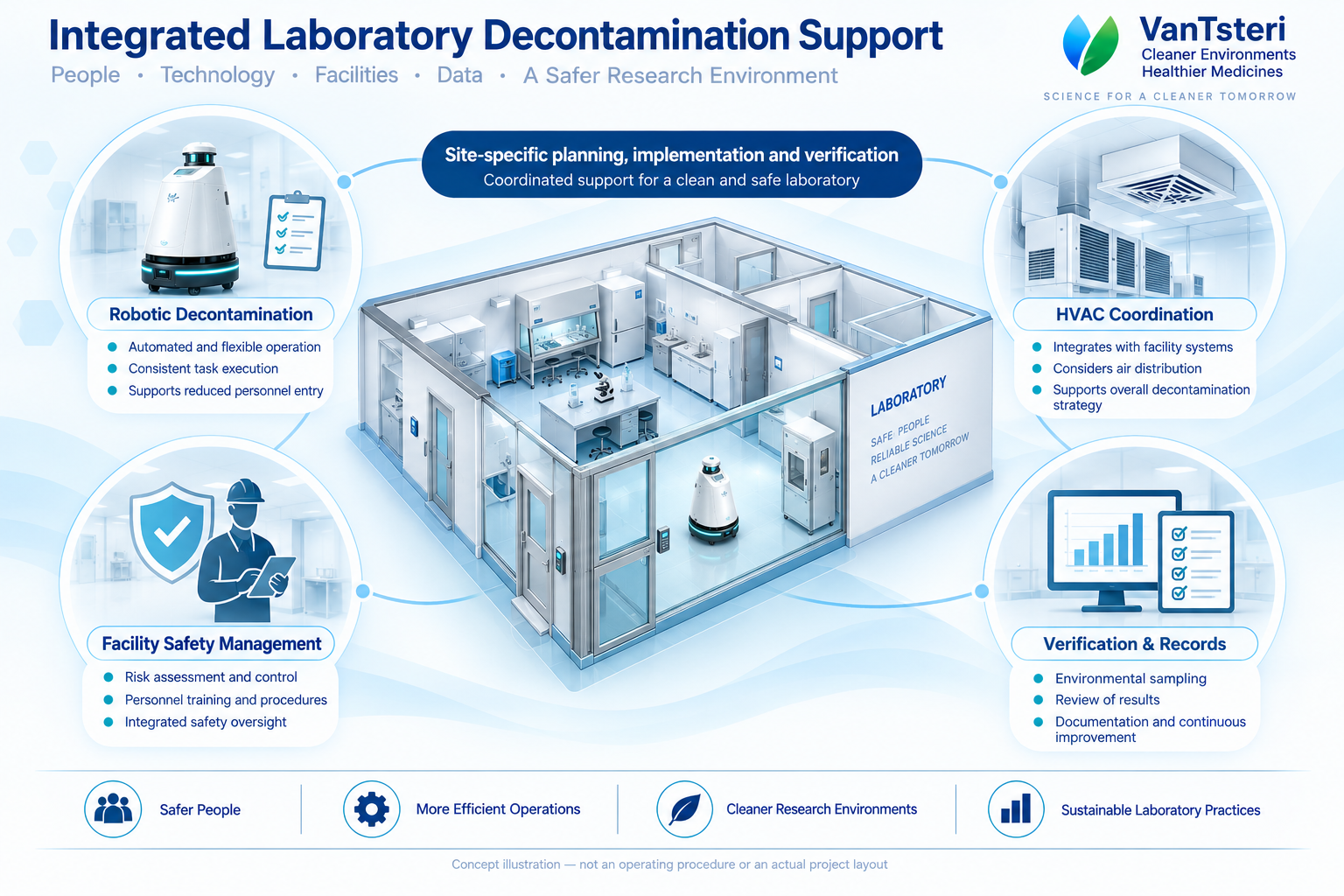
    Integrated laboratory decontamination support covering robotic decontamination, HVAC coordination, facility safety management and verification records
    Concept illustration — not an operating procedure or an actual project layout.

    Evidence with a clear application scope

    KINO PRO’s third-party testing summary covers simulated-use surface decontamination against specified microorganisms and compatibility with five tested metals. The findings apply to the equipment, materials and conditions in the respective reports.

    These reports do not establish whole-facility P3 certification or validation of negative-pressure HVAC coordination. VHP performance and material compatibility must be evaluated for the intended targets and conditions of the project.

    Read the KINO PRO testing & material compatibility summary →

    From service design to verified delivery

    Discuss your laboratory environment, equipment requirements and intended service scope with VanTsteri. We can help develop a project-specific approach to design, implementation and verification, with responsibilities and supporting documentation agreed with your team.

    Discuss laboratory decontamination support →

  • Pharmaceutical Contamination Control: From Investigation to Follow-Up

    Define the problem

    VanTsteri’s technical article describes contamination control as a coordinated approach to identifying microorganisms, locating contamination and evaluating whether corrective measures remain effective. A single satisfactory monitoring result does not establish the absence of contamination elsewhere.

    Investigate the system

    The proposed review combines historical air, surface, personnel, water and product monitoring with organism identification. Inspection and sampling consider material transfer, ventilation, building joints, moisture, equipment, pipework and water systems. Sampling locations should test a plausible contamination pathway rather than simply increase the number of samples.

    Choose a targeted response

    The source discusses cleaning, HVAC treatment, moisture and building repairs, biofilm control, water-system treatment and operational improvements. VHP decontamination is one possible measure; selection depends on the organism, location, material compatibility and verification requirements.

    Verify and maintain control

    The article recommends post-treatment checks, process records and continued trend review, with findings incorporated into deviation investigations and corrective actions. This technical overview provides no single customer-project outcome or universal treatment cycle.

  • Planning Decontamination in Cell Preparation Rooms

    Consider the room functions

    VanTsteri’s article discusses cell extraction and preparation, culture and recovery spaces. Planning should consider personnel and material movements together with the equipment used in each area.

    Include equipment and airflow

    The source highlights biosafety cabinets, workstations, refrigerators and incubators. Equipment operating states can affect airflow and pressure relationships; cold equipment and humidification systems also need attention in the assessment.

    Define the required treatment

    The proposed approach considers biological risks associated with starting materials and the actual facility conditions. Treatment selection and verification should be specific to the room and equipment rather than copied from another cleanroom. This is a technical overview, not a reported project with measured results.