VanTsteri's source article uses a narrative about a cold-chain contamination incident to discuss investigation across storage, transport and handling. It is presented here as an application discussion rather than a verified customer case.
Topics raised by the source
The discussion considers environmental sampling, temperature records, difficult-to-clean storage locations and the movement of goods between cold-chain stages. It proposes coordinating environmental treatment, monitoring and staff practices rather than relying on temperature control alone.
Evidence boundary
The source provides no original sequencing dataset, pathogen test report or complete project verification record. Its claim that brief temperature fluctuations created a specially adapted 'super' organism is not adopted here. No clinical outcome, strain identity across sites or quantified treatment performance is asserted.
VanTsteri's source article narrates recurring infections in a hospital ward. This page uses the article to discuss the scope of environmental investigation; it does not present the narrative as an independently verified outbreak report.
Response described in the source
The account describes collaboration with the hospital team and dividing the affected ward into three areas for differentiated environmental treatment. It highlights the need to consider room surfaces, difficult-to-clean locations and ventilation together.
Evidence boundary
Patient histories, organism identity, epidemiological linkage and the observation period are not supported by original records in the source. This page therefore makes no claim that environmental treatment prevented subsequent infections or caused patients to recover.
VanTsteri's article uses a cell-preparation narrative to explain how recurrent contamination may involve the wider working environment. This discussion is not presented as a verified customer case.
Investigation scope described
The source describes looking beyond a single handling step to the air system, biological safety cabinet, incubator and other less accessible equipment locations. Its proposed sequence begins with investigation and source assessment, followed by coordinated treatment of the affected equipment and environment.
Outcome boundary
The narrative reports that work returned to a stable condition after intervention. It provides no organism identity, sample counts, analytical results or defined follow-up interval, so this page does not claim measured clearance or permanent prevention.
Practical scope
The article's value is its system-wide investigation approach. It does not establish that a particular operator was responsible, that all contamination originates in HVAC, or that one treatment is sufficient for every cell-preparation facility.
For businesses using E. coli in industrial production, bacteriophage contamination can disrupt process stability, affect batch quality and lead to production losses, shutdowns or delayed deliveries. When the problem recurs, the priority is to understand the evidence and identify risks that an earlier response may have overlooked.
This technical service application describes VanTsteri’s approach to contamination investigation and environmental risk management. It is not an account of a single verified customer project.
A response can fall short when relevant contamination areas are missed. Unaddressed areas may contribute to renewed contamination, even after other parts of the facility have been treated.
Drawing on repeated on-site experience, VanTsteri has developed a dedicated approach that brings systematic investigation, targeted treatment and follow-up review together. The aim is to reduce omissions and support the return to production. The proprietary process is not disclosed here.
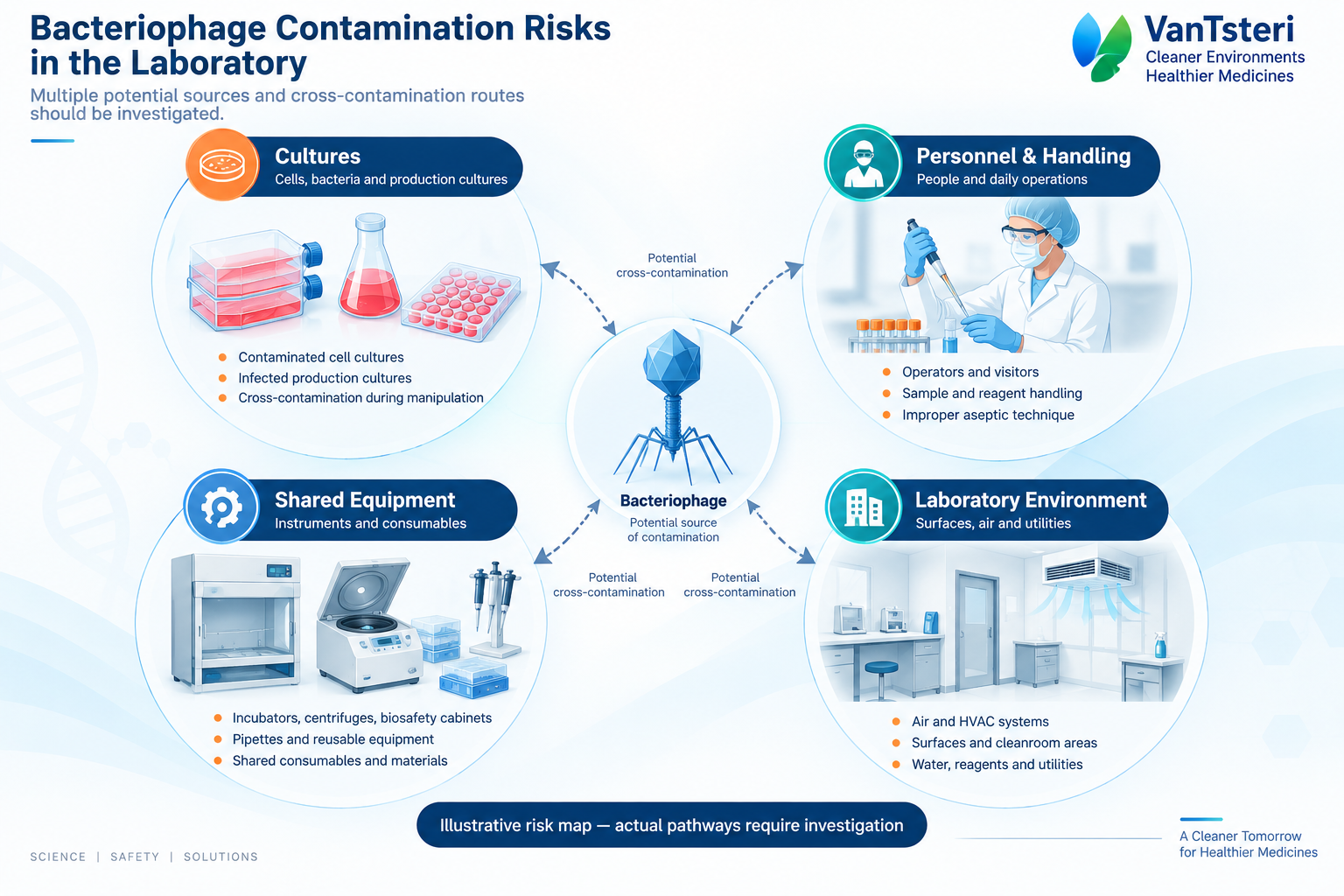
Illustrative bacteriophage risk map. Potential pathways require site-specific investigation; this is not a confirmed customer contamination map.
Reduce overlooked risks
Potential pathways
Consider several areas together
Investigation
Compare findings with site evidence
Targeted response
Address risks that may have been missed
Building an investigation from several lines of evidence
Investigation considers the timing of abnormalities, production records, available test findings and the site’s operating conditions. Equipment, pipework, the surrounding environment and related management practices are assessed together.
Findings need to be considered in context and compared with other evidence. A single positive result does not, by itself, establish the source of contamination or explain every recurrence.
Connecting findings with a targeted response
VanTsteri helps customers assess cleaning and decontamination needs for the environment and equipment, alongside relevant maintenance and management improvements. The response should address the identified risks and reflect the site’s actual conditions.
Investigation, treatment and outcome review form a connected service. This helps customers make clearer quality decisions and assess readiness to resume production, while reducing the risk that relevant areas remain unaddressed.
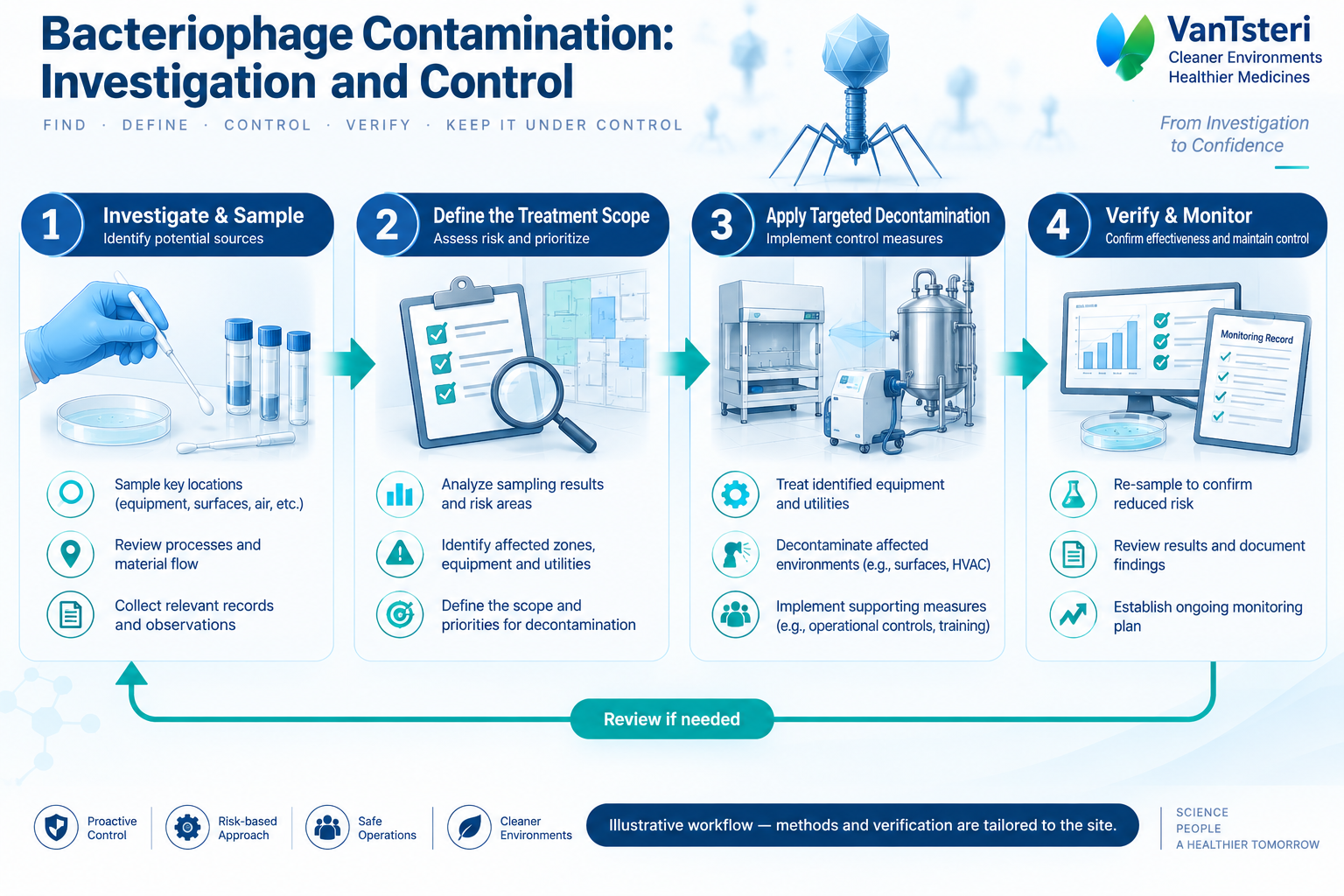
Illustrative investigation and control workflow. Methods and verification are tailored to the site; the graphic does not show measured project results.
A connected service
Investigate
Review findings and records
Define the scope
Assess the relevant risks
Respond
Coordinate targeted treatment
Review
Evaluate outcomes in context
Related technology: vaporized hydrogen peroxide
Vaporized hydrogen peroxide (VHP) is a related option that can be discussed when assessing environmental and equipment decontamination. Its suitability depends on the facility, equipment and evidence available.
The source article describes GHP gas decontamination. This page does not identify GHP as VHP or claim that a particular customer project used VHP. Related equipment is presented for assessment, not as evidence of bacteriophage performance in every application.
Post-treatment findings and subsequent production observations need to be evaluated against the testing scope and site conditions. A single test result does not establish complete elimination or permanent prevention.
The source provides no identifiable single-project validation dataset. Evidence and outcomes should be evaluated within the scope of the relevant project.
VanTsteri’s value lies in connecting contamination investigation, a response to overlooked risks and outcome review, helping customers manage quality and production disruption with clearer evidence.
VanTsteri’s technical article examines recurring mold findings in pharmaceutical clean areas. It focuses on how treatment evaluation and environmental monitoring can influence the interpretation of results.
Review sampling and recovery
The article identifies disinfectant carryover and a restricted sampling plan as possible reasons for overly favorable results. It recommends considering suitable neutralization and sampling locations that reflect the actual contamination risks.
Combine different evidence
Routine environmental counts and biological indicators address different questions. The source recommends combining treatment evaluation with monitoring under actual operating conditions. This article is a technical discussion, not a quantified customer case or a guarantee of mold eradication.
Refrigeration does not make an environment sterile. Some molds can grow at refrigeration temperatures, according to USDA FSIS. A cold-storage investigation should therefore consider moisture, affected materials, operating history and local conditions alongside temperature records. Refrigerated and frozen environments must not be treated as equivalent.
AI-generated cold-storage illustration, not a customer project photograph.
Why is the temperature reading only part of the picture?
A reading describes conditions at a particular sensor and time. An investigation also needs the location of the concern, its history and relevant operational changes. The fact that some molds can grow under refrigeration does not establish active growth at every subzero temperature or identify the organism present in a facility.
Why review moisture and facility conditions?
USDA FSIS explains that indoor mold needs moisture and a carbon source. For a facility discussion, observations of condensation, water ingress, drainage and affected materials can help frame the investigation. These observations are leads to assess, not proof of a particular contamination source. Source: USDA FSIS — Are molds the same as bacteria?
What information should a site review bring together?
Location and timing: where the concern appears, when it started and whether it recurs.
Operating context: available temperature records, door use, maintenance and relevant changes.
Available findings: photographs, laboratory reports and records of affected areas or materials.
Previous response: cleaning, repairs or treatment already performed and subsequent observations.
VanTsteri can use this information to discuss investigation requirements. The specific sampling and analytical scope should follow the questions that need answering at the site.
How should decontamination relate to corrective action?
On-site decontamination should be considered together with the conditions associated with the contamination concern. A treatment description alone does not establish that maintenance issues have been resolved or that recurrence has been prevented. Project outcomes should be recorded against agreed assessment criteria.
Where does low-temperature equipment fit?
KINO SUBZERO is VanTsteri’s Low-Temperature Vaporized Hydrogen Peroxide Decontamination System for air-conditioning systems and pipelines, with an operating capability down to −18°C as specified by VanTsteri. Equipment suitability must be assessed for the target system and project conditions. This specification is not a claim about mold growth at −18°C or a guarantee of a particular site outcome.
VanTsteri offers contamination investigation and equipment supply and remote decontamination support, with any on-site engineering scope agreed for the project. Share the project location, affected area, operating conditions and available findings to discuss the appropriate scope.
VanTsteri’s source discussion also considers differences between stored products and possible interactions between preservatives and oxidizing treatment agents. Product compatibility and the suitability of a treatment need assessment for the actual materials and conditions; no universal shelf-life extension is established.
Additional company-source context; not a customer-project result.
Why does mycoplasma contamination matter in cell culture?
Mycoplasma contamination can alter cell behaviour and compromise research findings. A control programme needs appropriate testing, a review of potential contamination routes and corrective action matched to the evidence. Environmental decontamination supports facility control; it does not demonstrate that an affected cell culture has been restored.
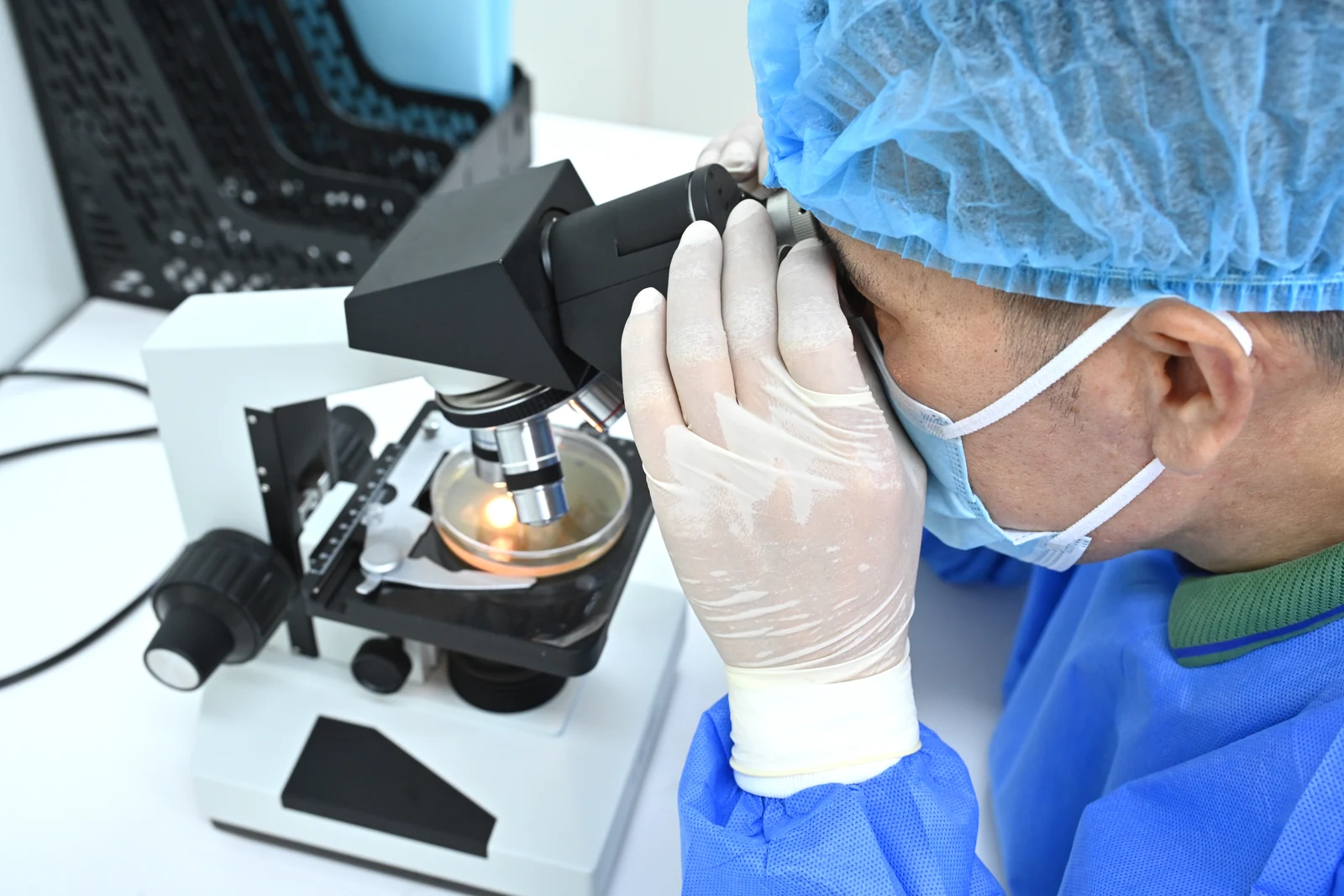
VanTsteri laboratory photograph. Routine microscopy shown here is not evidence of mycoplasma detection.
How can mycoplasma affect research reliability?
ATCC describes effects on cell growth, metabolism, gene expression and other cellular characteristics. Such changes can interfere with interpretation of experimental results. A contamination finding therefore calls for a review of affected work, not simply a change in the appearance of the laboratory. See ATCC’s explanation.
What role does testing play?
Assessment should rely on appropriate testing rather than visual appearance alone. ATCC describes culture-based and PCR-based detection approaches and recommends routine testing. The method and interpretation should suit the sample and laboratory requirements; a particular result must be considered with its sampling context and method limitations.
Which potential contamination routes should be reviewed?
ATCC discusses handling practices, equipment performance and the quality of media and reagents as relevant considerations. These provide starting points for investigation, rather than a diagnosis of the source at a particular site. Source: ATCC.
For a project discussion, bring together the incident timeline, affected cultures, available test findings, shared materials and equipment, and previous corrective actions. Comparing these records can help define what the investigation needs to resolve.
Do routine antibiotics provide reliable protection?
No. ATCC explains that standard cell-culture antibiotics do not reliably protect against mycoplasma. Their use should not be treated as evidence that a culture is contamination-free or as a substitute for testing. Read ATCC’s antibiotic guidance.
How do investigation and environmental decontamination fit together?
Investigation asks where contamination may have entered and how it may have spread. Environmental decontamination addresses a defined facility or equipment scope. A project should connect these activities with the client’s laboratory findings and corrective-action plan, while keeping the outcome claims specific to what was assessed.
A completed environmental treatment does not, on its own, establish that cell stocks are suitable for continued use. Decisions about cultures and experimental data belong within the laboratory’s quality procedures and assessment of the available evidence.
What support can VanTsteri provide?
VanTsteri provides microbial contamination investigation and equipment supply and remote decontamination support, with any on-site engineering scope agreed for the project. Share the facility location, affected areas, contamination history and available findings so the team can discuss a project-specific scope.
VanTsteri’s source discussion treats changes in culture appearance, cell morphology, growth and experimental consistency as warning signs that require testing. These observations do not establish mycoplasma infection or identify a contamination source.
Additional company-source context; not a customer-project result.
Potential sources include incoming cell cultures, media and reagents, consumables, shared equipment and laboratory personnel. Finding the source of a particular incident requires evidence: review what affected cultures shared, when the problem appeared and what testing found. Repeated contamination should prompt a coordinated investigation rather than an assumption that the room alone is responsible.
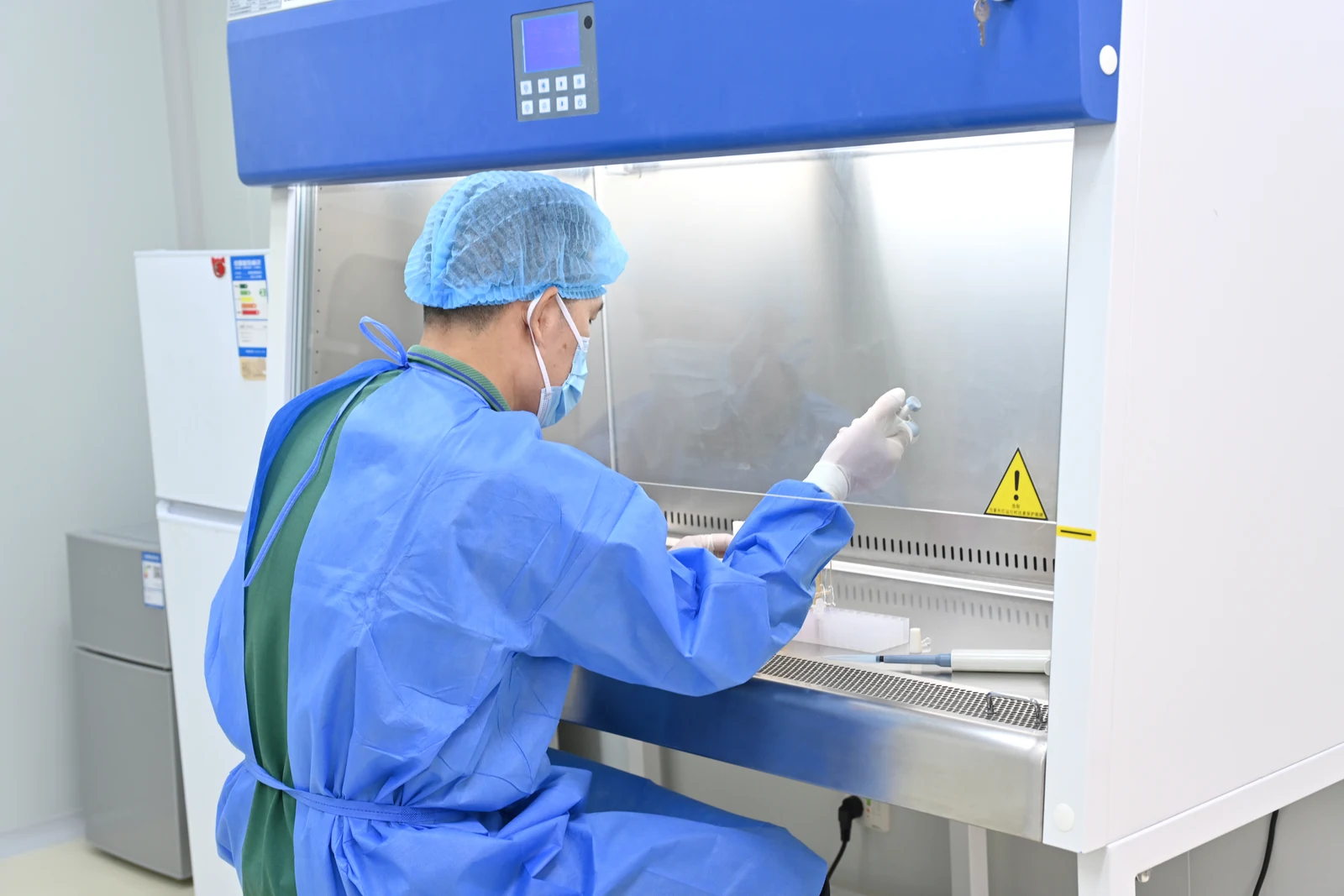
VanTsteri laboratory photograph. It does not identify the cause of a customer contamination incident.
Which potential sources should be reviewed?
ATCC identifies cell lines, reagents, supplies, equipment and personnel as potential contamination sources. A practical review can group the available records as follows:
Cells and materials: incoming cell lines, shared media or reagent batches, and associated quality records.
Personnel and workflow: shared handling steps, work areas and the sequence of activities.
Equipment and environment: shared cabinets and incubators, equipment condition, maintenance history and available environmental findings.
These are investigation categories, not proof of causation. A positive result in a room or on equipment does not by itself establish where contamination began or the direction of transfer. Read ATCC’s source overview.
Why can contamination recur after cleaning?
Recurrence raises questions about whether the original source, a transfer route or a repeated introduction has been addressed. Comparing affected and unaffected work, incident dates and previous corrective actions can help frame the investigation. The explanation must be established for the individual facility; recurrence alone does not identify a specific organism or source.
Can cultures look normal and still contain mycoplasma?
Yes. Mycoplasma contamination may lack obvious visual signs, so appearance alone cannot demonstrate that a culture is free of contamination. ATCC describes testing as an important part of mycoplasma control and explains why routine antibiotics do not provide reliable protection. Read ATCC’s mycoplasma guidance.
What information helps a contamination investigation?
For an initial discussion, assemble the incident timeline, available organism identification or test results, affected rooms and equipment, relevant material records, and previous corrective actions. Include the laboratory’s operating constraints so the investigation scope can be discussed in context.
The aim is to connect on-site observations with laboratory findings, assess potential sources and transmission routes, and provide a basis for targeted corrective action. Project-specific sampling and testing requirements depend on the facility and the question being investigated.
How can VanTsteri support contamination control?
VanTsteri provides microbial contamination investigation and equipment supply and remote decontamination support, with any on-site engineering scope agreed for the project. The service scope is planned around the facility, available findings and project requirements. Investigation and environmental treatment serve related purposes: treating an area does not itself establish the original contamination source.
VanTsteri’s source discussion considers ventilation, personnel and equipment together, including condensate, ductwork, biosafety cabinets and incubators. Findings in these locations are investigation leads, not proof of a single transmission route.
Additional company-source context; not a customer-project result.