Repeating validated paths under the conditions covered by the validation.
A coordinated response across multiple functional rooms
A pharmaceutical manufacturer commissioned VanTsteri to address mold contamination in a lyophilization workshop of approximately 500 m². The project included Grade C production areas and Grade A filling areas with a Grade B background.
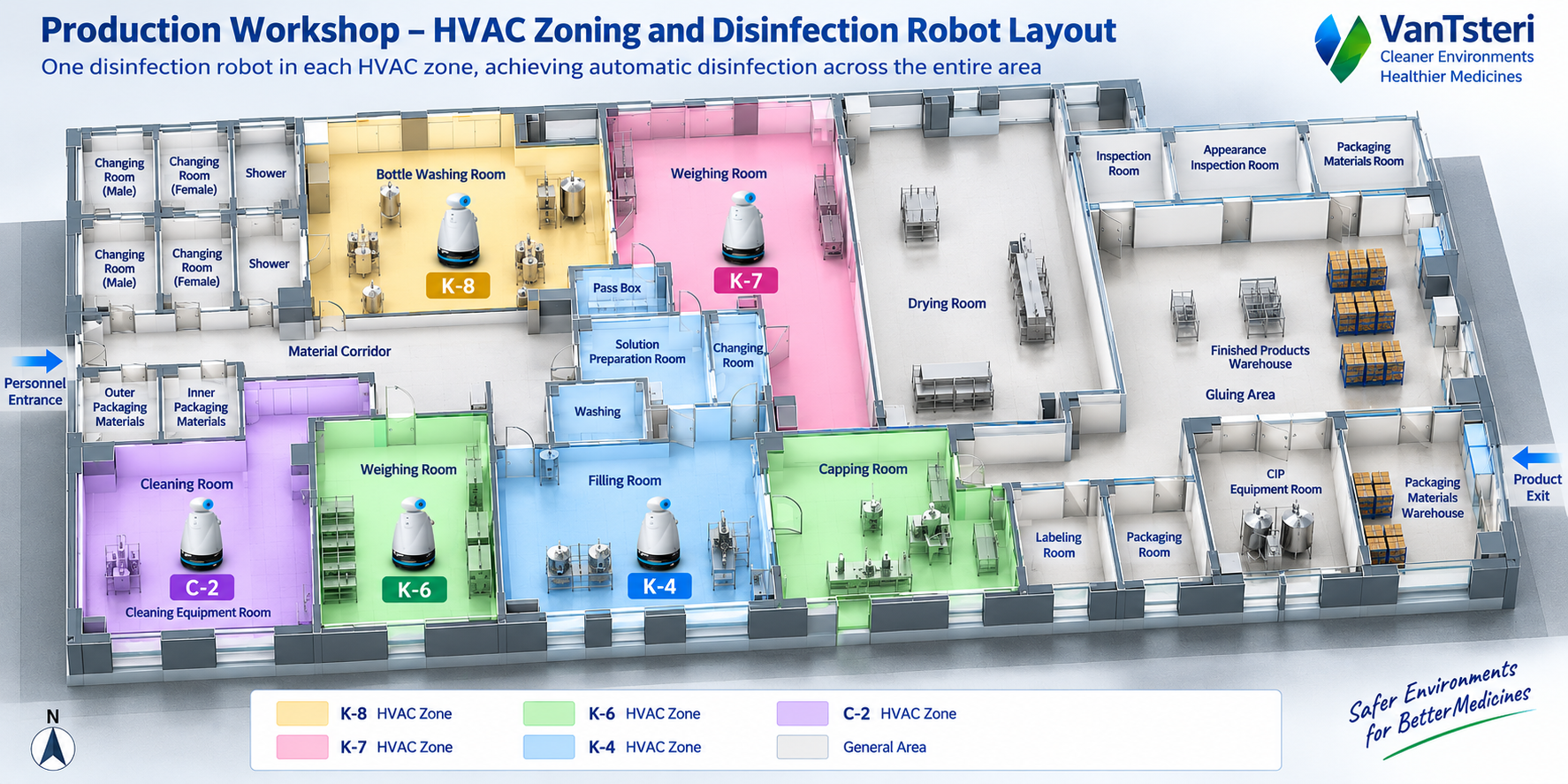
With multiple functional rooms and different production spaces, the response needed to account for the actual layout and coordinate treatment across the workshop.
VanTsteri combined decontamination robots with vaporized hydrogen peroxide (VHP) technology. The work included mapping the area, planning robot positions and paths, monitoring the decontaminating-agent concentration during treatment, and recording the process.
Illustrative pharmaceutical workshop layout and HVAC zoning.
The planning connected the robot’s work with the workshop’s rooms and production layout, providing a defined basis for treatment and subsequent evaluation.
According to VanTsteri’s project record, the chemical indicators (CI) and biological indicators (BI) met the project’s acceptance criteria. Project validation was used to evaluate the treatment outcome under the conditions at this site.
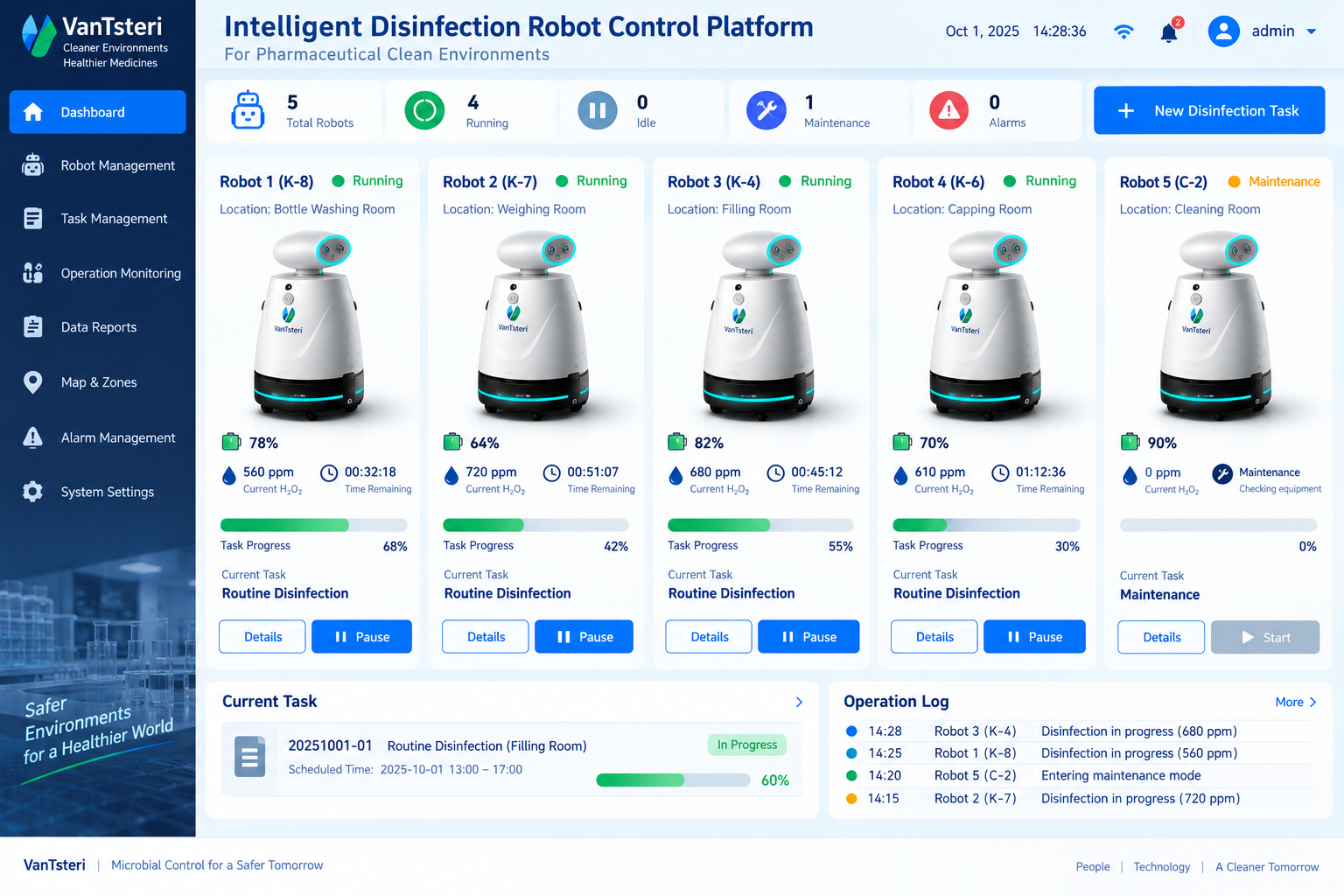
Illustrative robot control interface. Displayed data are not project records.
The project account reports that the treatment helped resolve the mold contamination problem and enabled the manufacturer to resume production. These reported findings apply to this project.
The value of repeating a validated path
When the site and process conditions remain within the scope covered by the validation, the robot can repeat the validated paths and positions. This reduces differences caused by ad hoc manual adjustments and supports repeatability, traceability and reliability in execution.
Repeating a path alone does not establish the effectiveness of every treatment. If the layout or process conditions change, the applicability of the existing validation needs to be reassessed.
If your pharmaceutical workshop has multiple functional rooms, discuss robotic VHP decontamination, project validation and repeatable execution with VanTsteri.
This anonymized case is based on VanTsteri’s project materials and information confirmed by its project representative. The customer’s identity is withheld.
The workshop image is an illustration, not the project’s actual layout. The control-platform image is illustrative; its robot icons, date and displayed values do not establish the equipment used or measurements from this project. The linked robot product is a related current offering, not an identification of the model used in this project.