Investigating mold contamination and coordinating rooms, equipment and HVAC.
Repeated treatment had not resolved the mold findings
A pharmaceutical manufacturer found mold during routine environmental monitoring in its aseptic filling area. Although the overall microbial counts met the site’s requirements, mold findings still required attention under the area’s strict contamination-control requirements. Repeated decontamination under the manufacturer’s existing procedures had not resolved the problem, so the customer asked VanTsteri to investigate.
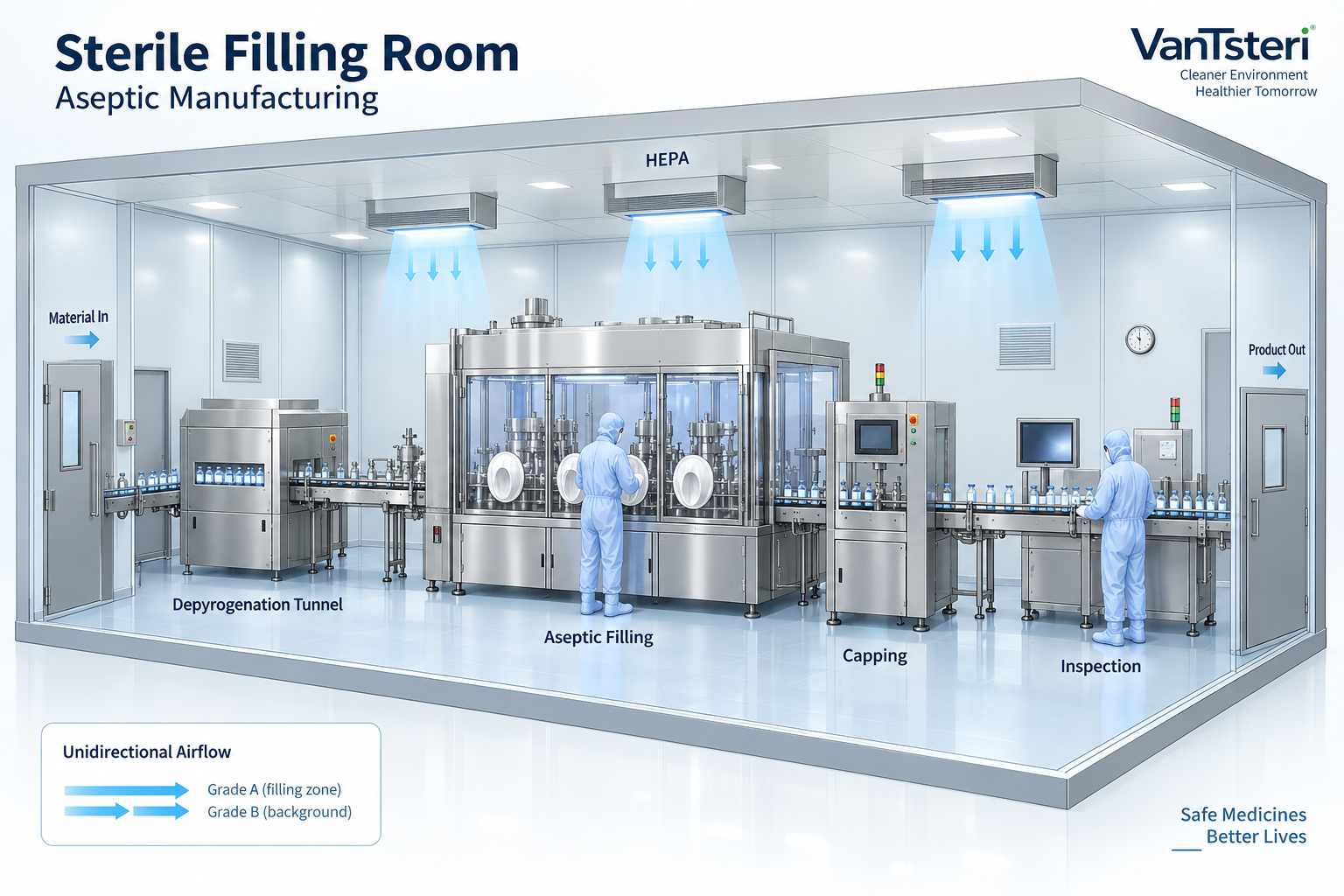
Illustrative aseptic filling environment.
Investigating the site before defining the response
VanTsteri investigated where mold contamination was occurring and considered possible pathways of spread. The site assessment covered filling, capping, freeze-dryer unloading and aseptic changing areas, together with the associated ventilation system.
The area had many small rooms, narrow corridors and obstructions formed by isolators and conveyors. These conditions meant that a single device could not suit every part of the treatment area.
VanTsteri used vaporized hydrogen peroxide (VHP) technology with a combination of portable units, an intelligent decontamination robot and dedicated HVAC decontamination equipment. The arrangement took account of the different spaces and equipment layout, coordinating treatment of the rooms, filling-related equipment and the associated HVAC system.
On-site work followed the customer’s aseptic operating requirements and controls on personnel access.
According to VanTsteri’s project account, the customer monitored for mold for seven consecutive days after treatment and did not find mold. During follow-up within the first year after treatment, no further mold problem was reported in the same area.
These observations apply to this project’s monitoring and follow-up scope.
A response shaped by the actual production environment
The value of this project was to bring the room layout, equipment obstructions and HVAC system into a coordinated response, rather than treating only readily accessible surfaces. VanTsteri provided decontamination support matched to the site, while the customer’s ongoing quality and production-area management supported subsequent contamination control.
If your aseptic production area is experiencing recurring mold contamination, discuss a site investigation and a coordinated room, equipment and HVAC treatment plan with VanTsteri.
This anonymized case is based on VanTsteri’s project materials and information confirmed by its project representative. The customer’s identity is withheld. The illustration shows a general aseptic filling environment, not the project’s actual layout or decontamination in progress.